As London prepares to host INTA 2026, the dispute between copyright owners and artificial intelligence developers is moving from abstract policy debate to live commercial and legal confrontation. In the UK, the latest flashpoint came in February 2026, when nearly 40 independent publishers, co-ordinated by the Independent Publishers Guild, sent letters of claim to several leading AI firms over the alleged use of books, journals and other literary works to train large language models without permission.
The move adds pressure to a legal landscape that remains unsettled after the High Court’s closely watched Getty Images case against Stability AI. According to legal commentary on the ruling, Getty dropped its main copyright claim after accepting it could not show that training took place in the UK, while the court rejected the remaining secondary infringement argument on the basis that the model did not store or reproduce Getty’s images in a way that amounted to infringing copies. Other reports on the judgment note that the court did, however, find limited trademark infringement linked to Getty watermarks in some generated outputs.
For rights holders, the problem is not simply that the courts have yet to settle the point. The UK government has also stepped back from a planned text-and-data-mining exception with an opt-out, saying in its March 2026 report on copyright and artificial intelligence that it no longer had a preferred option. That leaves publishers, authors and visual media groups without a clear statutory route, and AI companies without a settled rulebook for training on protected material.
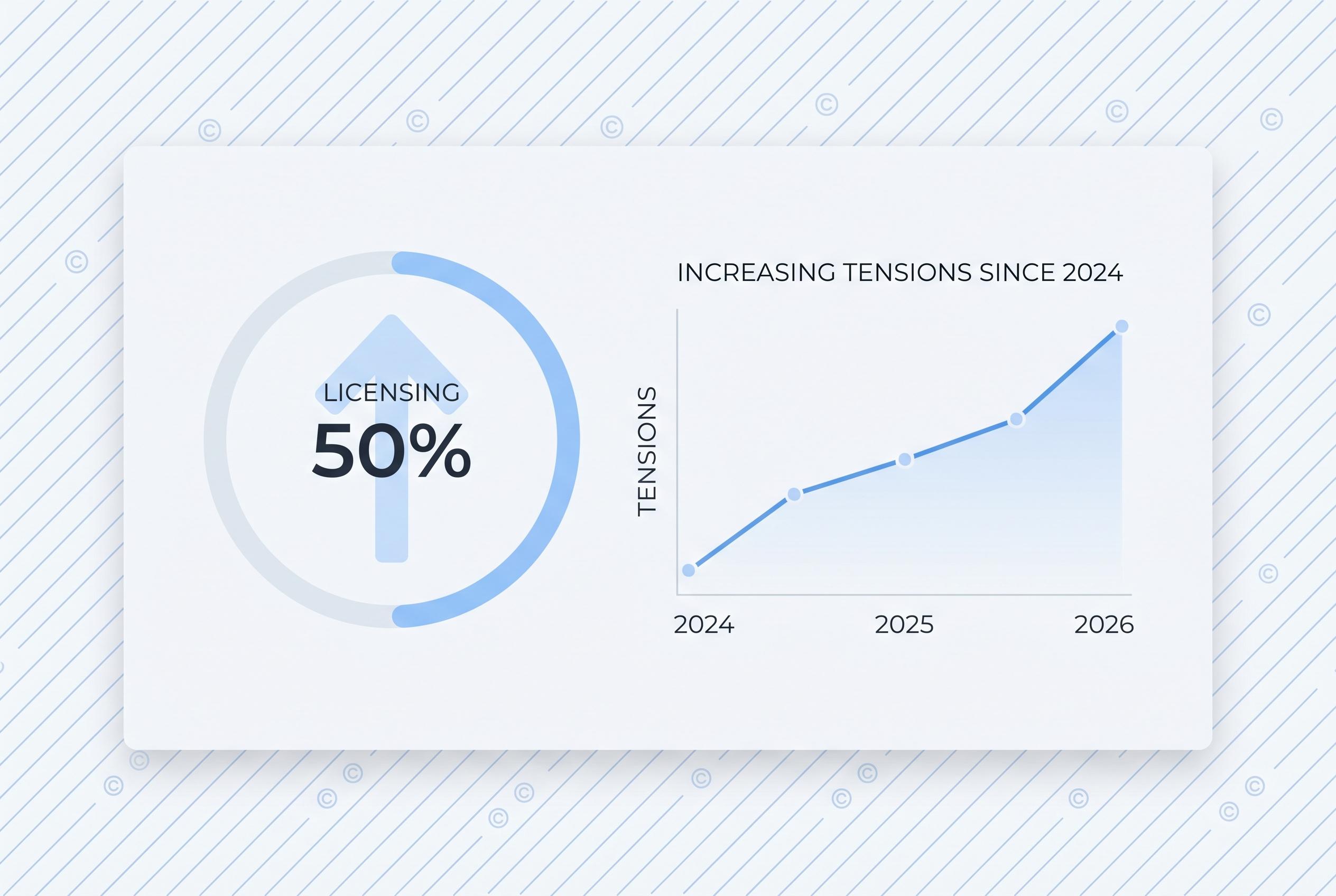
In that vacuum, licensing is increasingly becoming the more practical battleground. A new SPUR coalition involving the BBC, Sky News, the Financial Times, the Guardian and the Daily Telegraph says it wants to set shared technical standards and workable licensing models for publisher content. The Publishers Association has gone further, saying in a March 2026 report that the UK licensing market is already more developed than many had assumed, with the number of participating publishers expected to almost double by the end of the year and major academic houses set to join.
The commercial logic is also being tested elsewhere. Disney’s three-year licensing deal with OpenAI, announced in December 2025, was presented as evidence that major rightsholders and AI developers can reach large-scale agreements rather than wait for litigation to run its course. Although OpenAI later shut down Sora in March 2026, weakening the practical value of that arrangement, the deal still stood as a proof of concept for a market built on permission rather than dispute. Similar tensions are playing out in Germany, where a GEMA case on AI memorisation of song lyrics has been framed as a test designed to push negotiations forward, and in Europe more broadly, where the Court of Justice of the European Union is now considering its first generative AI and copyright referral. For UK rightsholders, the message is increasingly clear: the law may eventually be clarified in court, but licensing is the only route that is working in the present tense.
Source Reference Map
Inspired by headline at: [1]
Sources by paragraph:
- Paragraph 1: [2]
- Paragraph 2: [3], [4], [5], [6]
- Paragraph 3: [2]
- Paragraph 4: [2]
- Paragraph 5: [2], [1]
Source: Noah Wire Services