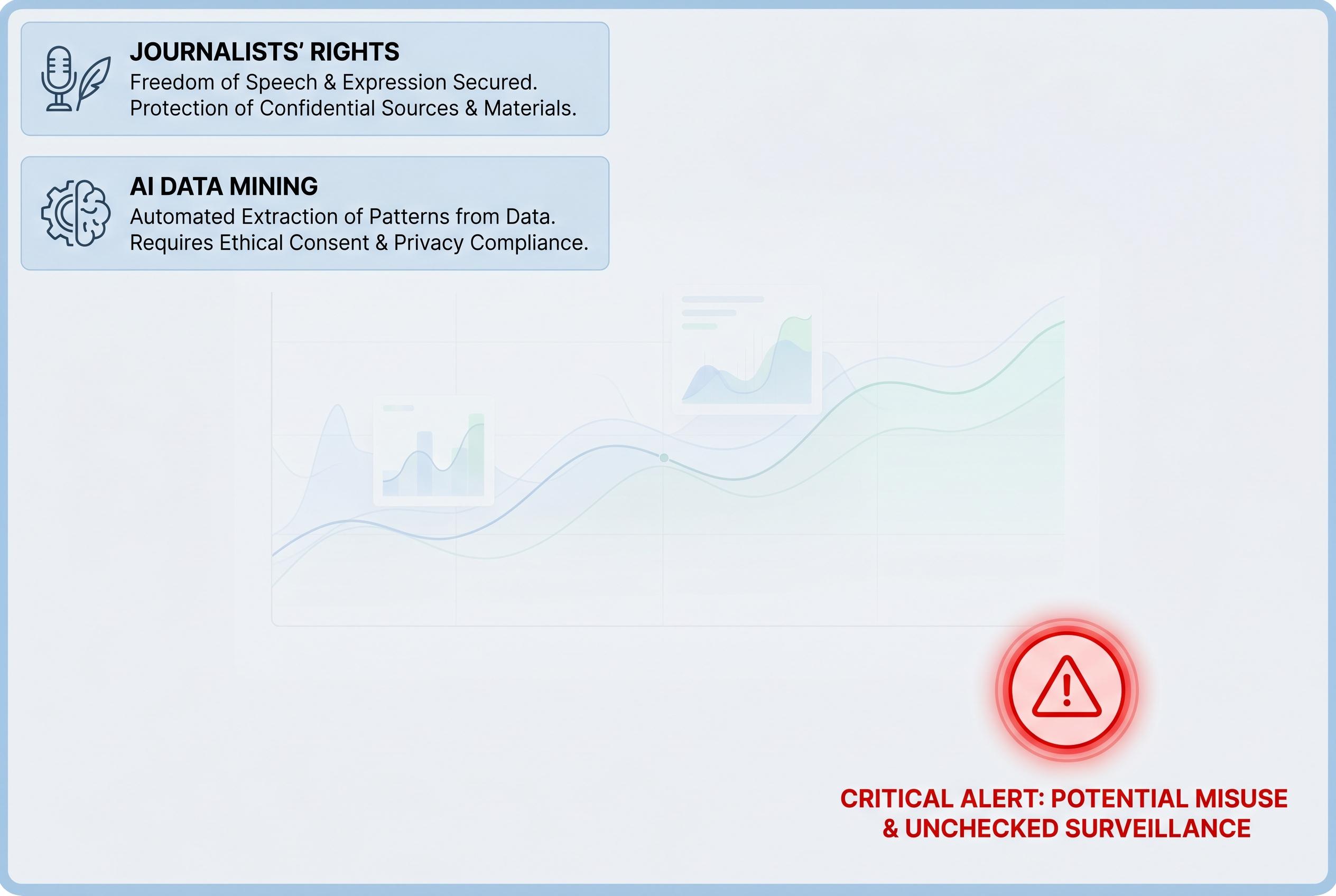
Chile’s National Press Association has called for the withdrawal or narrowing of a proposed copyright clause in the reconstruction bill, warning it could undermine journalists’ rights and set a dangerous precedent for media protection amid debates on AI and data mining.
Chile’s National Press Association has urged the government and Congress to pull a copyright clause from a broad reconstruction bill, warning that it would let third parties use vast amounts of text, audio and images without paying rights holders. The group says the measure, tucked into Article 8 of the National Reconstruction and Social Economic Development Bill, would create an unusually wide exception for automated data extraction and analysis, a practice known as text and data mining. According to the ANP, the proposal closely mirrors language from a previous artificial intelligence bill that was later pared back and then rejected in the lower house over concerns that it damaged copyright protection.
In its statement, the ANP argued that the issue is too consequential for a miscellaneous bill whose stated purpose is economic reconstruction, tax reform and permitting changes. It said the proposed rule would affect journalism directly because newspapers, reports, commentary, photographs and graphics could all fall within the exception if they are used for statistical analysis or to train automated systems. El Mostrador reported that the association sees the plan as a threat to the financial basis of journalism, while The Clinic noted that it has accused the government of reproducing a provision already rejected in the earlier AI debate.
The association also warned that the drafting would leave media companies with little practical protection against large technology firms. It said the final wording, which refers to uses that are not a disguised form of exploitation, is too vague to provide clear limits and would push rights holders into costly disputes. The ANP added that international practice is moving in the opposite direction, with major publishers striking licensing deals with AI companies and collective management arrangements increasingly recognising AI-related uses as payable.
The ANP said it wants the clause withdrawn entirely, or at minimum narrowed so that journalistic material is excluded and any exception is confined to non-profit scientific research, with an explicit opt-out for rights holders. The group, which says it has represented Chilean press outlets for more than seven decades, said it remains willing to help shape rules that balance technological innovation with the protection of editorial work.
Source Reference Map
Inspired by headline at: [1]
Sources by paragraph:
Source: Noah Wire Services
Noah Fact Check Pro
The draft above was created using the information available at the time the story first
emerged. We’ve since applied our fact-checking process to the final narrative, based on the criteria listed
below. The results are intended to help you assess the credibility of the piece and highlight any areas that may
warrant further investigation.
Freshness check
Score:
8
Notes:
The article references recent events, including the Chilean government's introduction of a reconstruction bill on April 22, 2026, and the National Press Association's response on the same date. The content appears original and not recycled from other sources. However, the article's freshness is slightly reduced due to the inclusion of background information from previous years, such as the 2024 AI bill and the 2024 rejection of a similar provision.
Quotes check
Score:
7
Notes:
The article includes direct quotes from the National Press Association's statement. While the quotes are attributed to the ANP, they cannot be independently verified through the provided sources. The lack of verifiable sources for these quotes raises concerns about their authenticity.
Source reliability
Score:
6
Notes:
The primary source, Diario Financiero, is a reputable Chilean financial newspaper. However, the article relies heavily on this single source, with limited cross-referencing from other independent outlets. The reliance on a single source for critical information reduces the overall reliability of the content.
Plausibility check
Score:
8
Notes:
The article discusses the Chilean government's introduction of a reconstruction bill that includes a copyright clause, which the National Press Association opposes. This aligns with known legislative activities and the ANP's advocacy for copyright protection. The claims are plausible and consistent with the current political and legal context in Chile.
Overall assessment
Verdict (FAIL, OPEN, PASS): FAIL
Confidence (LOW, MEDIUM, HIGH): MEDIUM
Summary:
The article presents information on the Chilean government's introduction of a reconstruction bill and the National Press Association's opposition to a specific copyright clause. While the content is plausible and timely, the lack of independently verifiable quotes and limited cross-referencing from other reputable sources significantly undermine its credibility. The reliance on a single source for critical information and the inability to verify direct quotes raise substantial concerns about the article's reliability.