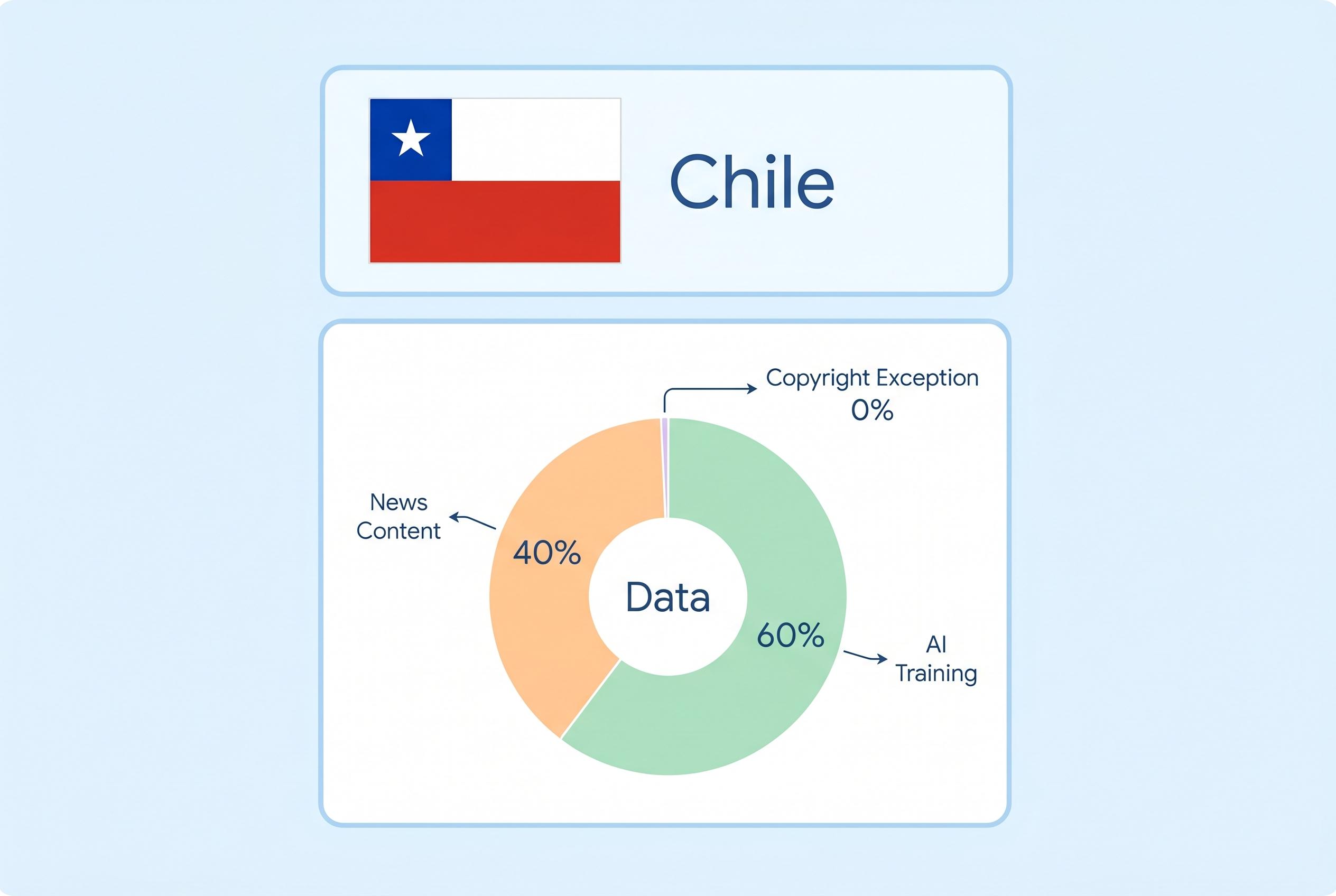
Chile’s proposed reconstruction bill has drawn sharp criticism from press and legal circles after it introduced a copyright carve-out that could allow large-scale use of published works, including journalistic content, for data analysis and artificial intelligence training without prior payment or permission. According to the draft described by Diario Financiero, the new clause would make it lawful to reproduce, adapt, distribute or communicate a lawfully published work when the purpose is extracting, classifying or statistically analysing large volumes of text, sound or images, so long as the use is not a disguised exploitation of protected material.
The National Press Association has asked the government to remove the provision, arguing that it weakens authorial rights and repeats language already tested and narrowed in an earlier AI bill. The association says that version was controversial because it extended only to non-profit scientific research and allowed rights holders to reserve their works, yet it still failed to clear the Chamber of Deputies. Chile’s copyright regime, set out in Law No. 17,336, is designed to protect both the economic and moral rights of creators, making the proposed exception a significant departure from the usual balance between access and control.
Felipe Harboe, a partner at H&CO Abogados and a former senator, told Diario Financiero that the wording suffers from serious drafting flaws and would reduce protection for journalistic works. He warned that media outlets could lose effective control over their content if technology companies were able to harvest and analyse it on a mass scale, while the undefined boundary around “covert exploitation” could leave publishers to prove infringement in court after the fact. Harboe also argued that the measure could strengthen the hand of major platforms in ongoing competition disputes by letting them claim that their conduct is now lawful.
Maximiliano Santa Cruz, a partner at Santa Cruz IP and a former head of Chile’s national intellectual property agency, said the language is unusually broad because it permits copying and analysis without payment or consent while relying on an uncertain limitation. He said the absence of an opt-out mechanism is a major weakness, since it removes a practical route for rights holders to exclude their material from these uses. Santa Cruz also noted that the text does not distinguish clearly between research and commercial exploitation, unlike the European Union’s approach, which he said separates those cases and allows rights holders to reserve their rights in commercial settings. By contrast, Cristóbal Porzio of Porzio Ríos García said the exception’s limit is carefully drafted and that substantial reproduction or reworking of journalistic content would still fall outside the protection of the rule.
Source Reference Map
Inspired by headline at: [1]
Sources by paragraph:
- Paragraph 1: [2], [6]
- Paragraph 2: [2], [4], [6]
- Paragraph 3: [1], [2]
- Paragraph 4: [1], [2], [3], [4], [5], [6], [7]
Source: Noah Wire Services