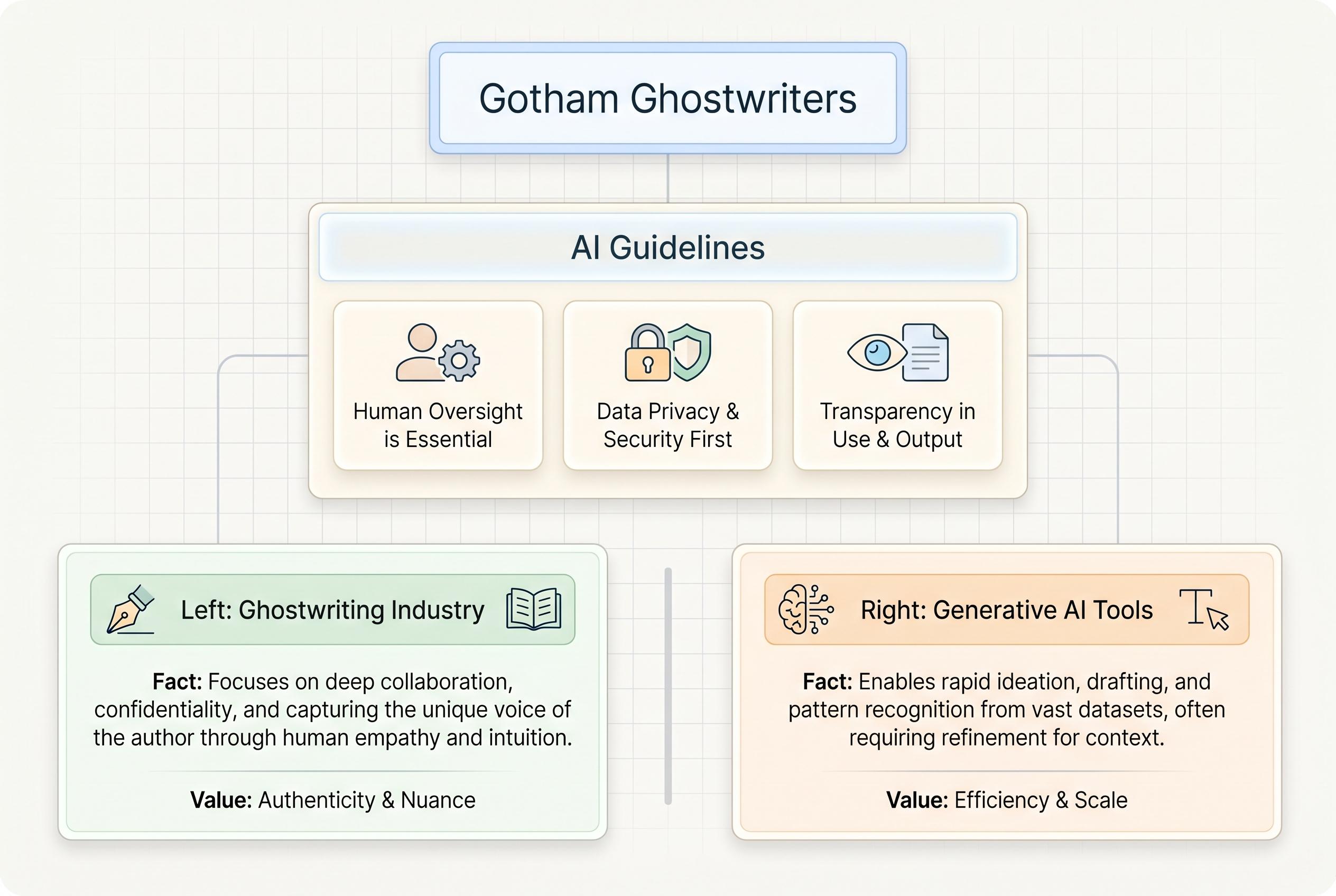
Gotham Ghostwriters has issued a set of AI use guidelines aimed at giving collaborative writers and their clients a common framework for handling a technology that is already reshaping parts of the profession. According to a Wednesday release, the document is designed to establish baseline standards for when and how generative tools may be used, while also giving both sides a clearer basis for discussing disclosure, permission and responsibility.
The guidance sets out a range of possible uses, from administrative help and research support to more ambitious generative work such as producing early text drafts or preliminary graphics. It also asks ghostwriters to spell out where AI has been used, reflecting a growing view in the field that transparency will matter as much as capability in the years ahead. Dan Gerstein, Gotham Ghostwriters' chief executive, said the aim is to help writers and clients work through what he described as a disruptive shift together, while trying to preserve the advantages of AI without losing sight of its risks.
Those risks are central to the document. Gotham’s list includes concerns over copyright eligibility for AI-generated material, the possibility that confidential information could end up in model training datasets, plagiarism in machine-produced text, errors in audio transcription and factual mistakes that can slip through as so-called hallucinations. The guidelines were drafted by a working group that included Alison Schwartz, president of Gotham Ghostwriters, Marcia Layton Turner, who founded the Association of Ghostwriters, and Lauren Hamlin, co-founder of Splash Literary, alongside other writers and journalists.
The release also builds on Gotham Ghostwriters’ wider research into how the profession is adapting to artificial intelligence. In a study published by the company in November 2025, 61% of respondents said they were already using AI tools, and more experienced users reported less anxiety about the technology’s impact. Gotham has also said that 74% of AI users in its research reported higher productivity, generally by applying the tools to brainstorming and research rather than full content generation. A separate 2025 report from the Association of Ghostwriters took a more cautious line, warning that AI-generated material is often seen as inferior to human writing and may face resistance from publishers, agents, editors and readers.
Even so, Gotham’s latest guidance is framed less as a warning than as a negotiation tool for a profession trying to define its place in an AI-driven market. The company says writers who use the technology more extensively tend to become more optimistic about its potential, and Gerstein has argued that the industry’s challenge is to broaden that view while keeping the conversation grounded in disclosure, ethics and craft.
Source Reference Map
Inspired by headline at: [1]
Sources by paragraph:
- Paragraph 1: [2]
- Paragraph 2: [2], [4]
- Paragraph 3: [2], [3]
- Paragraph 4: [4], [3], [5]
- Paragraph 5: [4], [5]
Source: Noah Wire Services