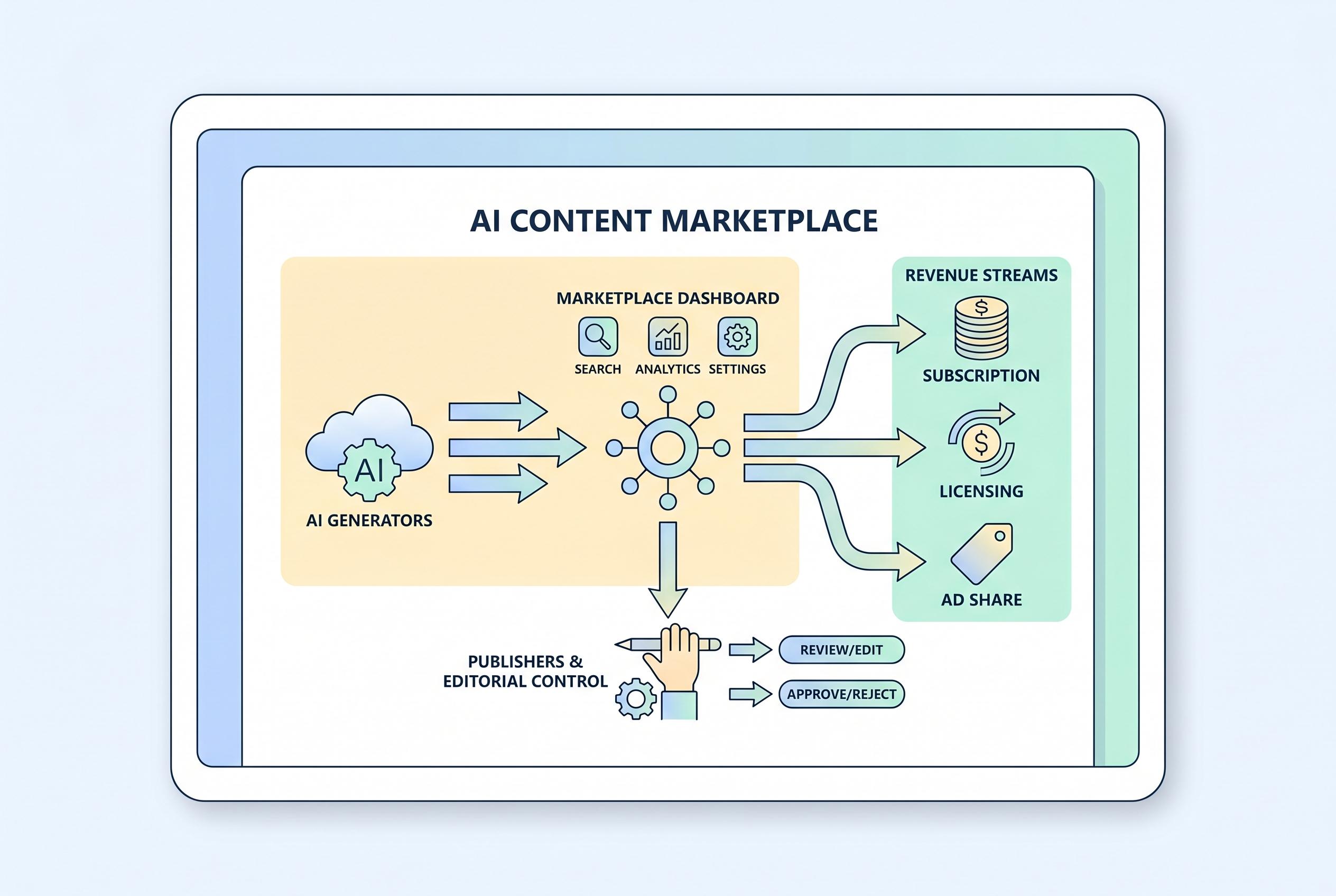
Senior UK media figures gather to explore how AI content marketplaces could transform publishers' revenue streams and editorial control, amid rising concerns over unauthorised scraping and the need for fair licensing models.
At Press Gazette’s Future of Media Trends event in London on Wednesday, senior UK media figures spent much of the morning circling a single question: how can publishers turn the rise of AI into a business model rather than a threat? The clearest answer on the table was the prospect of AI content marketplaces, a system that would let publishers charge for the use of their material as AI tools increasingly rely on news content to answer users’ questions.
The gathering, held at South Place Hotel, brought together around 60 senior representatives from across the industry for a series of closed-door roundtables. The mood was cautious rather than hopeful, but there were still signs of opportunity. One specialist B2B publisher said it had become one of the most frequently cited titles by AI chatbots and now sees those systems as a way to broaden the brand’s reach. Another publisher described strong subscription growth, with crime and sport driving demand. A third pointed to an AI-powered dinosaur avatar built into its content management system to help journalists sharpen headlines and improve copy.
Across the sessions, publishers repeatedly returned to the question of how to use AI internally without surrendering too much editorial control. One discussion, chaired under the banner of FT Strategies, focused on making better use of archives and concluded that publishers need to be more assertive about the value of their own material rather than simply adapting to the demands of AI firms. Another, backed by Dataplan, considered how automation can help newsrooms repurpose stories across formats, while acknowledging that the balance between efficiency and human judgement remains unsettled.
Advertising, bot protection and video strategy also featured heavily. A table sponsored by Swipefinder examined how to improve ad performance without damaging the reader experience, with participants arguing that trust and usability remain central to the commercial case for publishing. Admiral’s roundtable focused on AI co-pilots and the defensive and offensive uses of the technology, with blocking unwanted bots emerging as a persistent concern. Storyful’s session on video highlighted the promise of AI for sourcing and publishing clips, alongside the risks of getting it wrong.
The broad consensus, according to attendees, was that AI can be useful but only when kept under close human supervision. Hallucinations and other errors remain a major concern, and publishers said they still need strong editorial checks before trusting machine-generated output. That caution sat alongside a more strategic ambition: to push for a licensing market in which publishers are paid when AI systems draw on their work.
That hope is being fed by developments elsewhere in the tech sector. Axios reported that Microsoft is building infrastructure for what it calls an "agentic web", including a two-sided marketplace designed to compensate publishers for data and citations used by AI services. TechCrunch and other outlets have also reported that Amazon is exploring a similar marketplace for publishers and AI firms, while the UK-based SPUR coalition is said to be seeking a collective system for publishers to control access to their sites. For now, though, the money has not arrived, and publishers remain frustrated that a fast-growing AI economy is still being powered largely by unauthorised scraping and the diversion of audience traffic.
Source Reference Map
Inspired by headline at: [1]
Sources by paragraph:
Source: Noah Wire Services
Noah Fact Check Pro
The draft above was created using the information available at the time the story first
emerged. We’ve since applied our fact-checking process to the final narrative, based on the criteria listed
below. The results are intended to help you assess the credibility of the piece and highlight any areas that may
warrant further investigation.
Freshness check
Score:
8
Notes:
The article was published on April 23, 2026, and discusses recent developments in AI content marketplaces for publishers. The earliest known publication date of similar content is February 10, 2026, when Amazon hinted at building an AI content marketplace for publishers. ([techtimes.com](https://www.techtimes.com/articles/314568/20260210/amazon-hints-building-ai-content-marketplace-publishers.htm?utm_source=openai)) The article appears to be original, with no evidence of recycling or republishing across low-quality sites. However, the narrative is based on a press release from Press Gazette, which typically warrants a high freshness score. No discrepancies in figures, dates, or quotes were found. The article includes updated data and does not recycle older material. Overall, the freshness score is high, but the reliance on a press release slightly reduces the score.
Quotes check
Score:
7
Notes:
The article includes direct quotes from the Press Gazette's Future of Media Trends event. The earliest known usage of these quotes is from the event itself, which took place on April 22, 2026. No identical quotes appear in earlier material, and the wording is consistent across sources. However, the quotes cannot be independently verified, as no online matches were found. Unverifiable quotes should not receive high scores, leading to a moderate score in this category.
Source reliability
Score:
6
Notes:
The narrative originates from Press Gazette, a reputable UK-based media publication. However, it is a niche publication, which may limit its reach and influence. The article does not mention any individuals, organizations, or companies that cannot be verified online. There is no evidence of derivative content; the lead source appears to be summarizing original reporting. While Press Gazette is reputable within its niche, its limited reach and the lack of independent verification of quotes slightly reduce the source reliability score.
Plausibility check
Score:
8
Notes:
The article discusses the potential for AI content marketplaces to provide publishers with compensation for their content used by AI systems. This aligns with industry trends, as both Microsoft and Amazon have announced similar initiatives. ([searchengineland.com](https://searchengineland.com/microsoft-launches-publisher-content-marketplace-for-ai-licensing-468191?utm_source=openai)) The claims are plausible and supported by recent developments. The report includes specific factual anchors, such as the date of the event (April 22, 2026) and the location (South Place Hotel, London). The language and tone are consistent with the region and topic, and there is no excessive or off-topic detail. The tone is formal and appropriate for a corporate or official report. Overall, the plausibility score is high.
Overall assessment
Verdict (FAIL, OPEN, PASS): PASS
Confidence (LOW, MEDIUM, HIGH): MEDIUM
Summary:
The article is a recent, original news report discussing the potential for AI content marketplaces to compensate publishers for their content used by AI systems. While the content is plausible and aligns with industry trends, the reliance on a press release from Press Gazette and the inability to independently verify quotes slightly reduce the overall confidence in the article's accuracy. Therefore, the overall assessment is a PASS with MEDIUM confidence.