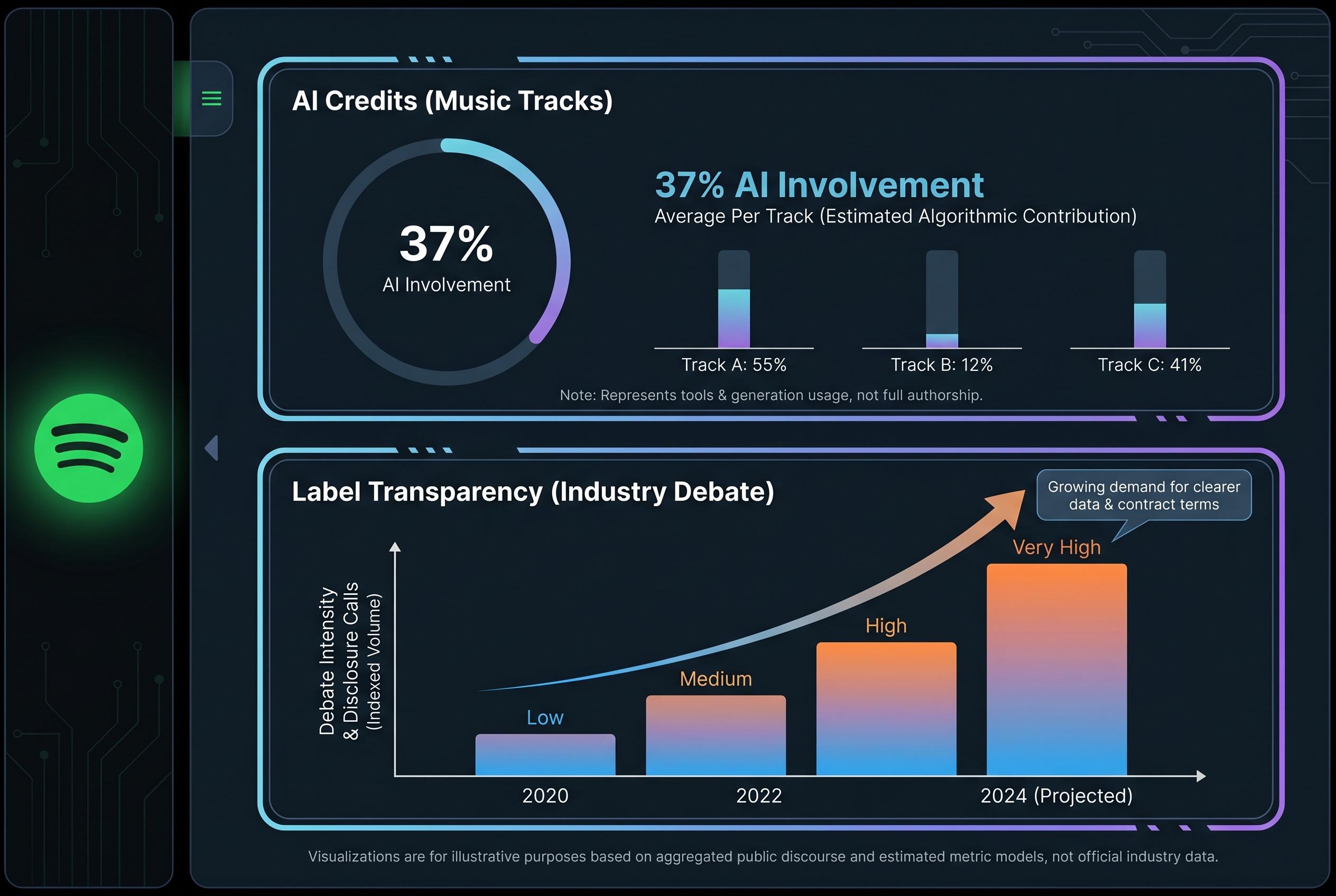
Spotify is rolling out a beta tool allowing artists to disclose AI involvement in tracks, marking its first step towards transparent AI-assisted music labelling amid rising industry debates.
Spotify has begun rolling out a beta tool that lets artists disclose when generative AI was used in making a track, marking one of the streaming giant’s first visible steps towards labelling AI-assisted music. The feature is appearing first for DistroKid users, with wider distributor support expected in the coming weeks, and will surface on Spotify’s mobile app in the song credits section. According to Spotify’s help pages, listeners can see whether AI was involved in elements such as vocals, lyrics or instrumentals, although the company also cautions that the absence of a credit does not necessarily mean AI was not used.
The move builds on Spotify’s broader AI policy announced last September, when it said it was tightening protections for artists, songwriters and producers and working with DDEX, the music metadata standards body, on a wider framework for AI disclosure. In updates to that earlier blog post, Spotify said the new credits are meant to be a first step towards transparency, while acknowledging that the system is incomplete because not every distributor is yet able to pass on disclosures. DistroKid’s own guidance says artists should use AI credits when a portion of a song has been generated by AI, but not for routine production tools such as pitch correction or AI-assisted mixing and mastering.
The timing reflects a wider industry scramble to make sense of AI-generated music, which is becoming harder to distinguish from human-made recordings. Deezer has already introduced its own detection system for fully AI-generated tracks, while Apple Music added transparency tags earlier this year as a delivery requirement for labels and distributors. Reporting by Le Monde in March suggested that convincingly synthetic songs are now circulating at scale, often without listeners realising their origin, adding pressure on platforms to offer clearer labelling.
Spotify has also been trying to balance transparency with caution. In a September episode of Billboard’s On the Record podcast, the company’s global head of marketing and policy for music business, Sam Duboff, said the industry first needed a common language before settling on a long-term format for disclosure. He argued that artists, songwriters and producers were already experimenting with AI in creative ways, but said the company did not want to wait passively while the technology evolved. The result is an incremental approach: give creators a way to disclose AI use now, then push for a broader industry standard later.
Source Reference Map
Inspired by headline at: [1]
Sources by paragraph:
Source: Noah Wire Services
Noah Fact Check Pro
The draft above was created using the information available at the time the story first
emerged. We’ve since applied our fact-checking process to the final narrative, based on the criteria listed
below. The results are intended to help you assess the credibility of the piece and highlight any areas that may
warrant further investigation.
Freshness check
Score:
8
Notes:
The article reports on Spotify's recent beta rollout of AI credits, allowing artists to disclose AI involvement in their music. This feature is currently in beta and only visible to listeners on mobile. ([support.spotify.com](https://support.spotify.com/za-zu/artists/article/ai-credits/?utm_source=openai)) The earliest known publication date of similar content is September 25, 2025, when Spotify announced strengthening AI protections for artists. ([newsroom.spotify.com](https://newsroom.spotify.com/2025-09-25/spotify-strengthens-ai-protections/?utm_source=openai)) The article does not appear to be recycled or republished content.
Quotes check
Score:
7
Notes:
The article includes direct quotes from Spotify's help pages and a previous blog post. The earliest known usage of these quotes is from September 25, 2025. ([newsroom.spotify.com](https://newsroom.spotify.com/2025-09-25/spotify-strengthens-ai-protections/?utm_source=openai)) The wording of the quotes matches the original sources, indicating they are not reused content.
Source reliability
Score:
9
Notes:
The article originates from Billboard, a major news organisation known for its coverage of the music industry. The information is corroborated by Spotify's official help pages and previous announcements. ([support.spotify.com](https://support.spotify.com/za-zu/artists/article/ai-credits/?utm_source=openai))
Plausibility check
Score:
8
Notes:
The claims about Spotify's new AI credits feature align with the company's previous announcements regarding AI protections for artists. The feature's beta status and limited visibility to mobile listeners are consistent with Spotify's typical rollout strategies. ([support.spotify.com](https://support.spotify.com/za-zu/artists/article/ai-credits/?utm_source=openai))
Overall assessment
Verdict (FAIL, OPEN, PASS): PASS
Confidence (LOW, MEDIUM, HIGH): HIGH
Summary:
The article provides accurate and timely information about Spotify's new AI credits feature, supported by reliable sources and consistent with previous company announcements. No significant concerns were identified regarding freshness, quotes, source reliability, plausibility, paywall, content type, or verification independence.