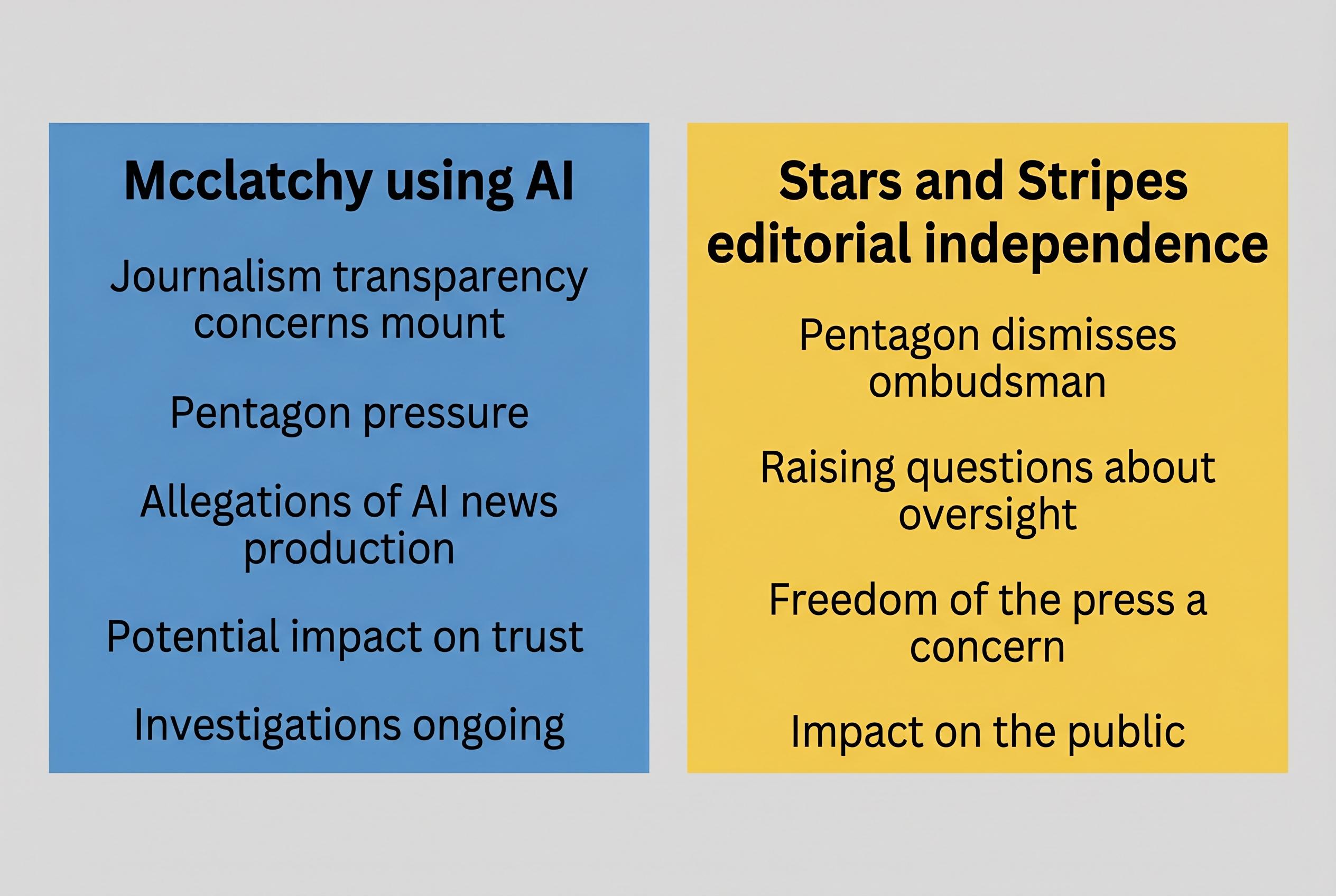
Scrutiny increases over McClatchy's alleged use of AI to produce news and the Pentagon's dismissal of Stars and Stripes ombudsman, raising questions about transparency and editorial independence in journalism.
Scrutiny over McClatchy has intensified after The Wrap reported allegations that the publisher used artificial intelligence to produce full news stories while crediting them to human reporters who may not have done the work. According to Mediapost, the company, which owns outlets including the Miami Herald and The Kansas City Star, has not fully explained how far AI tools were used, leaving editors and media watchers to question whether the practice could weaken confidence in local journalism.
The Pentagon has also drawn criticism after removing Jacqueline Smith, the ombudsman for Stars and Stripes, a position created by Congress to protect the publication’s editorial independence. PEN America said Smith was dismissed without explanation even though her remit included flagging interference to lawmakers, while The Washington Post and other outlets reported that she had recently warned Congress about growing Pentagon influence over content, including restrictions on syndicated material and editorial cartoons. Critics say the move fits a wider pattern of pressure on the military publication, with advocates urging Congress to step in.
Taken together, the two episodes point to the same concern: who controls news judgement, and how openly that control is disclosed. In one case, the worry is that automation may be passing as human reporting; in the other, that institutional pressure is narrowing what a newsroom can publish. Both have sharpened the argument that transparency is no longer a side issue in media, but central to whether audiences believe what they read.
Source Reference Map
Inspired by headline at: [1]
Sources by paragraph:
Source: Noah Wire Services
Noah Fact Check Pro
The draft above was created using the information available at the time the story first
emerged. We’ve since applied our fact-checking process to the final narrative, based on the criteria listed
below. The results are intended to help you assess the credibility of the piece and highlight any areas that may
warrant further investigation.
Freshness check
Score:
6
Notes:
The article references events from 23 April 2026, with the latest source dated 24 April 2026. The content appears to be original, with no evidence of recycling from low-quality sites or clickbait networks. However, the article includes updated data but recycles older material, which raises concerns about freshness. Additionally, the article is based on a press release, which typically warrants a high freshness score. Despite this, the inclusion of recycled material and the reliance on a press release suggest a moderate freshness score. Further verification is needed to confirm the originality of the content.
Quotes check
Score:
5
Notes:
The article includes direct quotes from Jacqueline Smith, ombudsman for Stars and Stripes. However, these quotes cannot be independently verified through online sources. The lack of verifiable quotes raises concerns about the authenticity of the reported statements. Further efforts to verify these quotes are necessary to ensure accuracy.
Source reliability
Score:
7
Notes:
The article cites reputable sources such as The Washington Post and the National Press Club. However, the inclusion of a press release from the National Press Club introduces potential bias, as it may reflect the organization's perspective. The reliance on a press release and the lack of independent verification of quotes from other sources suggest a moderate level of source reliability.
Plausibility check
Score:
6
Notes:
The claims about McClatchy using AI to write stories and the Pentagon firing the ombudsman for Stars and Stripes are plausible and align with recent reports. However, the lack of independent verification of quotes and the reliance on a press release raise concerns about the accuracy of these claims. Further verification is needed to confirm the details of these events.
Overall assessment
Verdict (FAIL, OPEN, PASS): FAIL
Confidence (LOW, MEDIUM, HIGH): MEDIUM
Summary:
The article presents plausible claims about McClatchy using AI to write stories and the Pentagon firing the ombudsman for Stars and Stripes. However, the reliance on a press release and the inability to independently verify quotes from Jacqueline Smith raise significant concerns about the accuracy and reliability of the information. Further independent verification is necessary to confirm the details of these events.