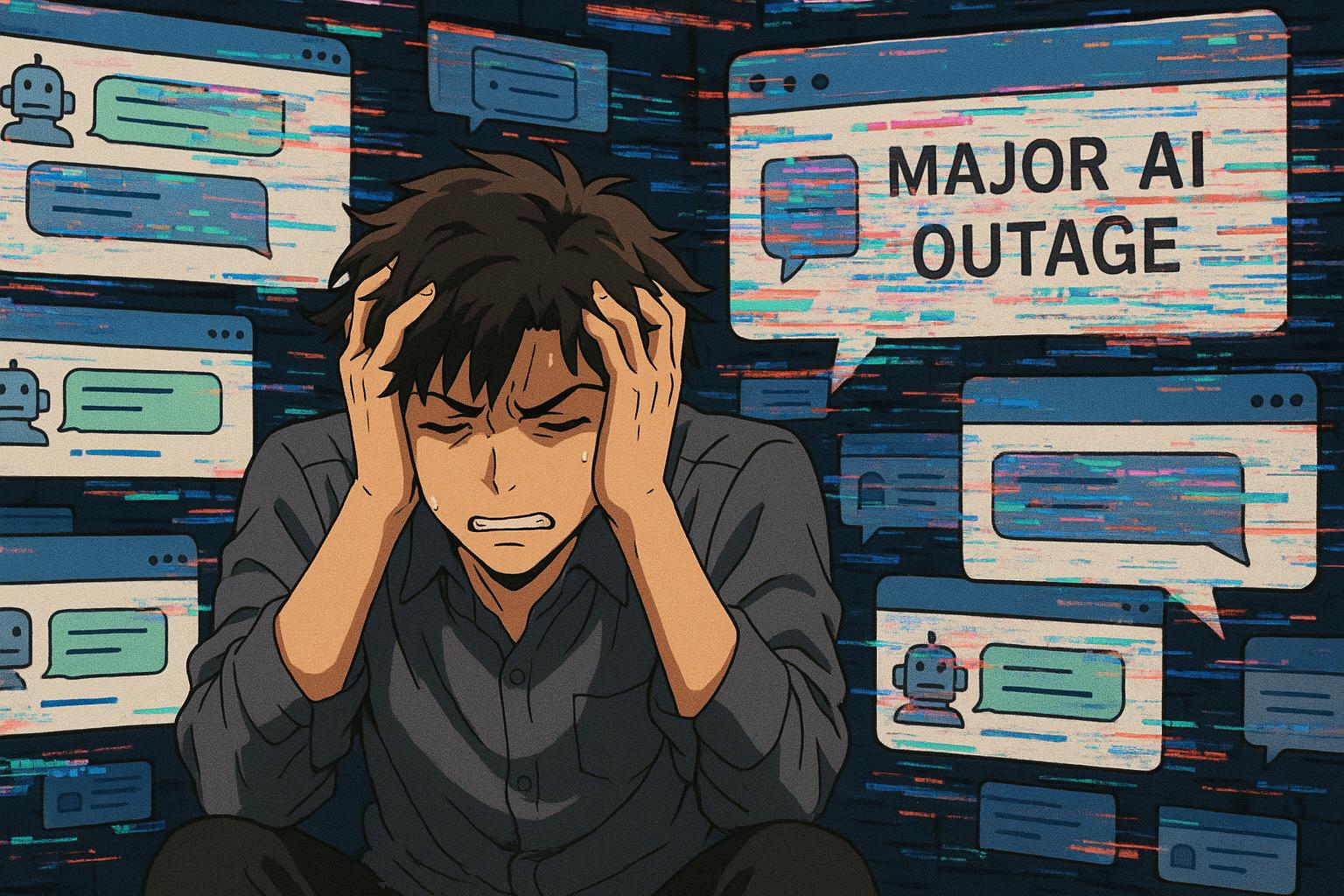
The global reliance on artificial intelligence was starkly illustrated on 10 June 2025, when OpenAI's ChatGPT suffered a major outage, lasting over ten hours and impacting millions of users worldwide. As erratic error messages like "Too many concurrent requests" flooded screens, workflows across multiple sectors ground to a halt, fuelling widespread panic. Google search data quickly reflected the turmoil, with 'ChatGPT Down' trending as the second most searched term in America, accumulating half a million queries. British users similarly reported disruptions that hindered the operations of businesses, educational institutions, and creative professionals.
OpenAI's status updates confirmed that the outage stemmed from elevated error rates and latency not only in ChatGPT but also affecting its entire suite of services, including the Sora video tool and critical APIs. These elements are integral to countless applications, leaving users grappling with delayed processes, particularly in voice mode functionality, which lagged even longer. The incident prompted users to search for alternatives, indicating a readiness to transition to competing platforms during service interruptions.
In the wake of ChatGPT's outage, alternatives such as Anthropic’s Claude and Google Gemini saw marked increases in user traffic. Searches for Claude nearly doubled, while queries for Gemini surged sharply, suggesting a growing willingness among users to explore new options. Marc Porcar, CEO of QR Code Generator PRO, highlighted this trend, stating, “That’s a clear signal that users perceive alternatives as just that—alternatives... and they’re ready to jump ship during an outage.” Additionally, DeepSeek experienced a substantial 109% rise in traffic as users sought immediate substitutes.
The emergence of competitors like Claude and Gemini highlights the potential for a significant shift within the AI landscape, suggesting users may adopt multi-platform strategies to ensure operational continuity. Claude, which focuses on safety and stability, and Gemini, known for its integration within Google’s ecosystem, represent alternatives that could ultimately offer more than just performance—they promise resilience against outages. This trend towards diversifying AI resources could herald a new era where users maintain an array of tools rather than relying on a single model, ultimately fortifying their operational capacities.
OpenAI’s response to the outage has generated mixed reactions. While the company attributed the breakdown to issues it subsequently worked to mitigate, critics noted the lack of a formal apology or compensation for the inconvenience. Despite claims of a “full recovery” by the day’s end, many users remained sceptical regarding the reliability of the service. This unprecedented disruption poses critical questions for OpenAI: Will the company bolster its infrastructure to avert similar issues in the future, or could this outage signify the dawn of a fragmented AI ecosystem where ChatGPT becomes merely one of several available tools?
As services began to restore, one key consideration surfaced: Have we, in our rapid ascent toward embracing AI, inadvertently constructed a digital single point of failure that could drastically impact productivity whenever these systems falter? The ramifications of this incident extend beyond mere technicalities; it serves as a potent reminder of our increasing dependence on AI technologies—and the subsequent need for robust fail-safes. As enterprises adapt to these lessons, they may well begin to prioritise redundancy in their AI frameworks, cultivating a diverse toolbox of solutions to prepare for any future disruptions.
📌 Reference Map:
- Paragraph 1 – [1], [2]
- Paragraph 2 – [1], [4], [3]
- Paragraph 3 – [3], [5], [6]
- Paragraph 4 – [1], [7]
- Paragraph 5 – [1]
- Paragraph 6 – [1]
Source: Noah Wire Services