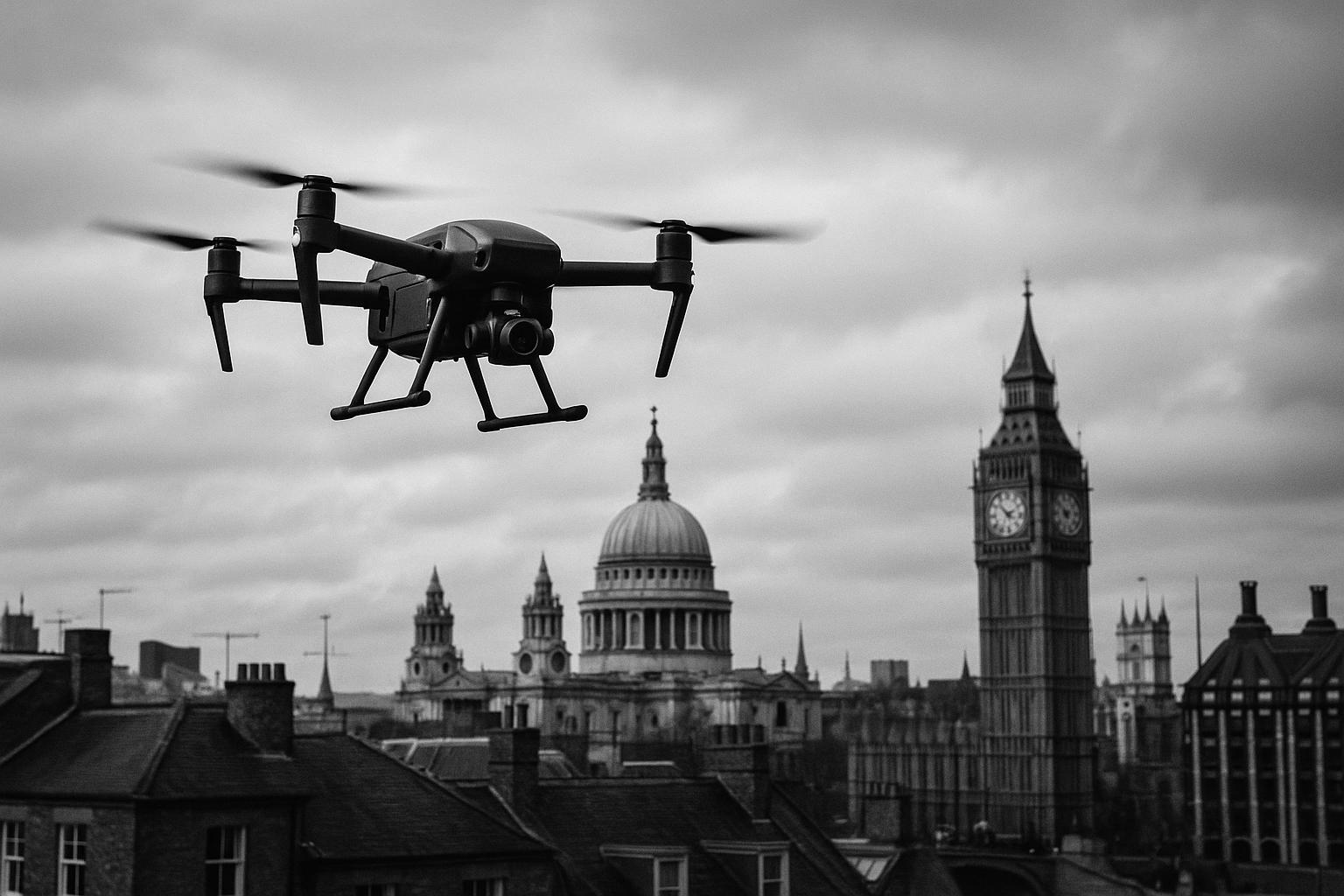
The Metropolitan Police Service is pioneering the use of remotely launched drones in London to enhance emergency response capabilities through a new initiative known as Drone as First Responder (DFR). The drones, controlled from a central command room, will deploy rapidly to incident scenes, often arriving within two minutes, providing live aerial footage that supports officers on the ground. This technology aims to improve the precision and efficiency of police operations across a range of scenarios, including searching for missing people, identifying suspects, and securing evidence early in investigations.
This innovative approach, initially launched in Islington, will expand to two further locations—covering West End and Hyde Park—before the year’s end. The drones, which are stored on the rooftops of selected police buildings in weatherproof charging boxes, navigate autonomously to incident sites after remote deployment and return automatically once a mission is complete. The Met describes these new drones as quicker, quieter, and more cost-effective than traditional police helicopters while offering equivalent operational benefits.
Assistant Commissioner Laurence Taylor, who leads the national drones programme, highlighted the strategic advantage of immediate aerial support in rapidly evolving situations. Speaking on the Met’s initiative, he explained that drones bring clarity to complex or chaotic scenes, enabling more informed decision-making regarding resource allocation and suspect apprehension, thus reducing the need for extensive manual searches. Uniquely, these drones operate beyond the traditional line-of-sight constraint, flying autonomously with ability for human pilots to take control as necessary, which considerably improves agility and speed of response.
Superintendent Taryn Evans, overseeing the NPCC’s Drones Programme, described the technology as a “gamechanger” in policing, emphasising its tested effectiveness in both urban and rural settings from trials conducted over the past two years. The Met’s deployment is part of a broader national initiative, with other forces such as Norfolk, Cleveland, West Midlands, Hampshire & Isle of Wight, and Thames Valley also trialling drone technology for policing purposes.
This application of drones in emergency services aligns with broader trends across UK emergency and defence sectors. For instance, HM Coastguard has been trialling drones in search and rescue missions to assist with locating missing persons and performing water rescues, demonstrating the device’s value in life-saving operations. Similarly, the Maritime & Coastguard Agency alongside the RNLI conducted tests to assess drones in various rescue scenarios, aiming to improve both operational reach and the safety of rescue teams.
Further innovation includes UK military experiments with advanced drone-neutralising weapons and robotic systems capable of chemical detection, 3D mapping, and casualty identification, which points to an increasing integration of unmanned technology in public safety and defence. Defence trials have shown the ability of single operators to manage multiple autonomous vehicles, enhancing reconnaissance and operational safety for army personnel.
Taken together, these developments indicate a significant shift toward autonomous and remotely piloted technologies as critical tools in emergency response and security. The Metropolitan Police’s DFR initiative represents a strategic step in modernising law enforcement capabilities by harnessing the speed, flexibility, and detailed intelligence that drone technology can provide.
📌 Reference Map:
- Paragraph 1 – [1] (The Independent)
- Paragraph 2 – [1] (The Independent), [2] (Reuters)
- Paragraph 3 – [1] (The Independent)
- Paragraph 4 – [1] (The Independent)
- Paragraph 5 – [1] (The Independent), [2] (Reuters)
- Paragraph 6 – [1] (The Independent), [4] (gov.uk), [5] (gov.uk)
- Paragraph 7 – [1] (The Independent), [3] (gov.uk), [6] (gov.uk), [7] (gov.uk)
Source: Noah Wire Services