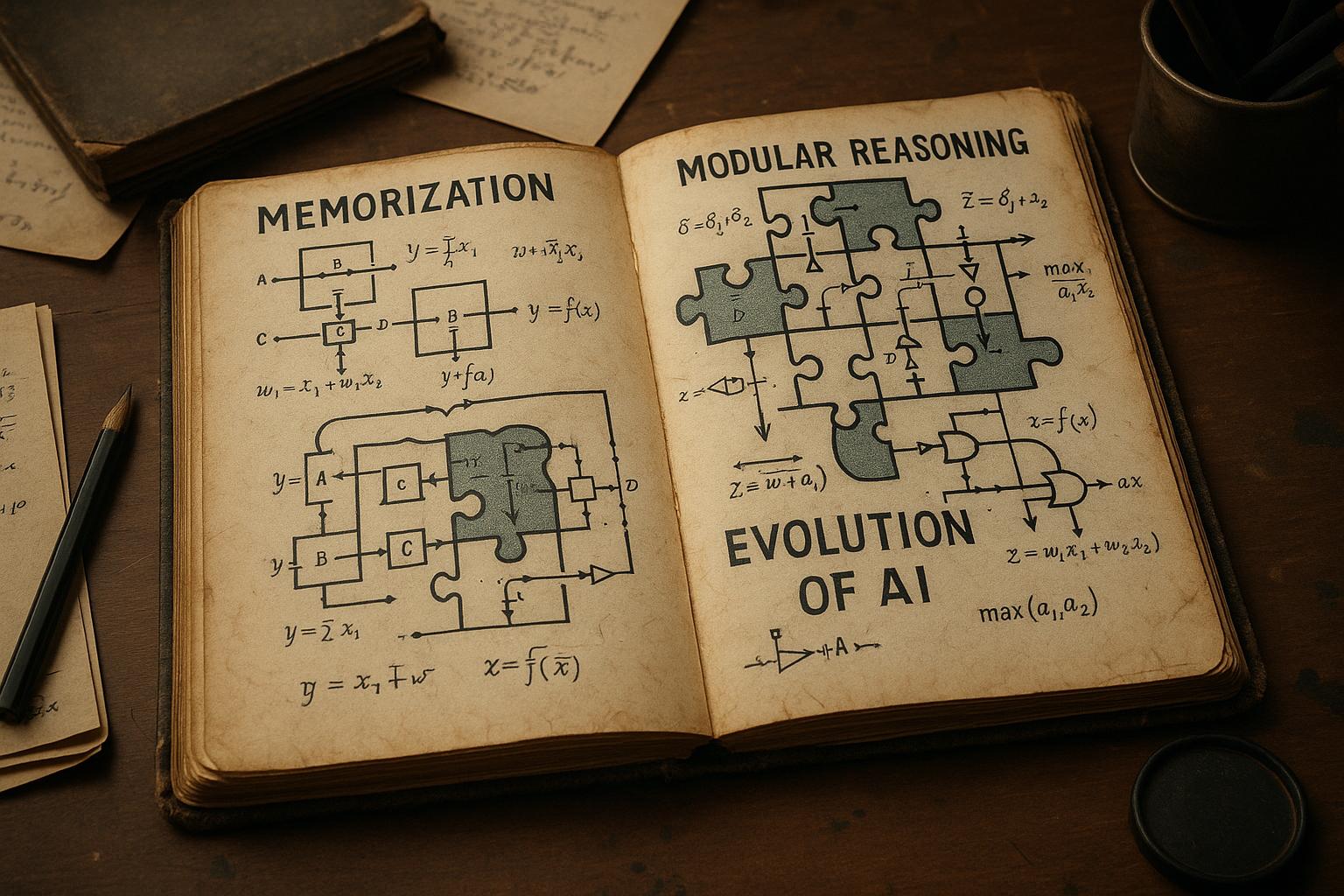
The next frontier in artificial intelligence signals a shift from sheer scale and memorisation to more nuanced reasoning and efficiency. OpenAI founding member Andrej Karpathy has articulated concerns about current AI models, which, while adept at mimicking information, often suffer from "blurry reasoning" due to reliance on vast amounts of memorised internet data. These models deliver remarkable capabilities, yet true reliability and deeper understanding—essential for dependable AI—remain elusive. Karpathy proposes a streamlined approach: a "cognitive core" at roughly a billion parameters that functions more like a librarian than a library, focusing on problem decomposition, planning, and selectively querying facts instead of indiscriminately storing information. This concept envisions AI less as a monolithic knowledge vault and more as an agile problem-solving agent.
Complementing this perspective, philosopher Toby Ord has highlighted the inherent limits of current AI methodologies that depend heavily on post-training reinforcement learning and extended inference-time reasoning. According to Ord, these methods consume 1,000 to 1,000,000 times more computational power per insight than classical training approaches. This exponential energy and resource cost constrains progress, with diminishing returns making the next milestones increasingly expensive. Both Karpathy and Ord suggest that future AI development will veer away from brute-force memorisation and towards modular, tool-using agents that allocate reasoning resources more judiciously. This implies a departure from massive, all-encompassing models to flexible, specialised systems that balance between pre-trained knowledge and real-time information retrieval, marking a fundamental change in AI design philosophy.
As the cost dynamics evolve, usage-based pricing models for AI services are poised to become the norm, rewarding firms that deploy AI with precision. This transition could result in a broader and more incremental integration of AI technologies into diverse areas of the economy, rather than a single dramatic leap in productivity or GDP growth.
In line with these advances, OpenAI recently launched Atlas, an AI-enhanced web browser that integrates ChatGPT directly into the browsing experience. This innovation aims to redefine how users interact with the internet by embedding AI assistance in everyday tasks such as summarising web pages, form filling, and remembering user preferences. Initially released on macOS with plans to roll out to Windows, iOS, and Android, Atlas challenges the dominance of established browsers like Google Chrome and Apple’s Safari. According to OpenAI, Atlas could not only improve navigation efficiency but also capitalise on ChatGPT’s massive user base, potentially driving new revenue streams through AI-enhanced digital advertising.
However, Atlas’ launch has not been without controversy. Security experts have raised alarm bells about intrinsic vulnerabilities within the browser. Built on Chromium and integrated with AI, Atlas has been found susceptible to indirect prompt injection attacks. This method could allow malicious actors to manipulate the browser’s AI capabilities via crafted web content, thereby risking user data and behavioural compromise. These security concerns inject a degree of caution into what is otherwise a bold step forward in AI-powered browsing, underscoring the challenges of integrating AI deeply into widely used everyday software.
Ultimately, the emergence of simpler, smarter AI architectures and the debut of AI-native tools like OpenAI’s Atlas browser paint a picture of a maturing AI landscape. One where deeper reasoning, efficient compute usage, modularity, and security considerations define the path forward, shaping how AI will permeate and enhance both technological ecosystems and everyday life.
📌 Reference Map:
- Paragraph 1 – [1] Exponential View, [2] YouTube (Andrej Karpathy)
- Paragraph 2 – [1] Exponential View, [3] Toby Ord
- Paragraph 3 – [1] Exponential View
- Paragraph 4 – [1] Exponential View, [4] OpenAI, [6] MacRumors, [7] AP News
- Paragraph 5 – [5] TechRadar
- Paragraph 6 – [1] Exponential View, [4] OpenAI, [5] TechRadar
Source: Noah Wire Services