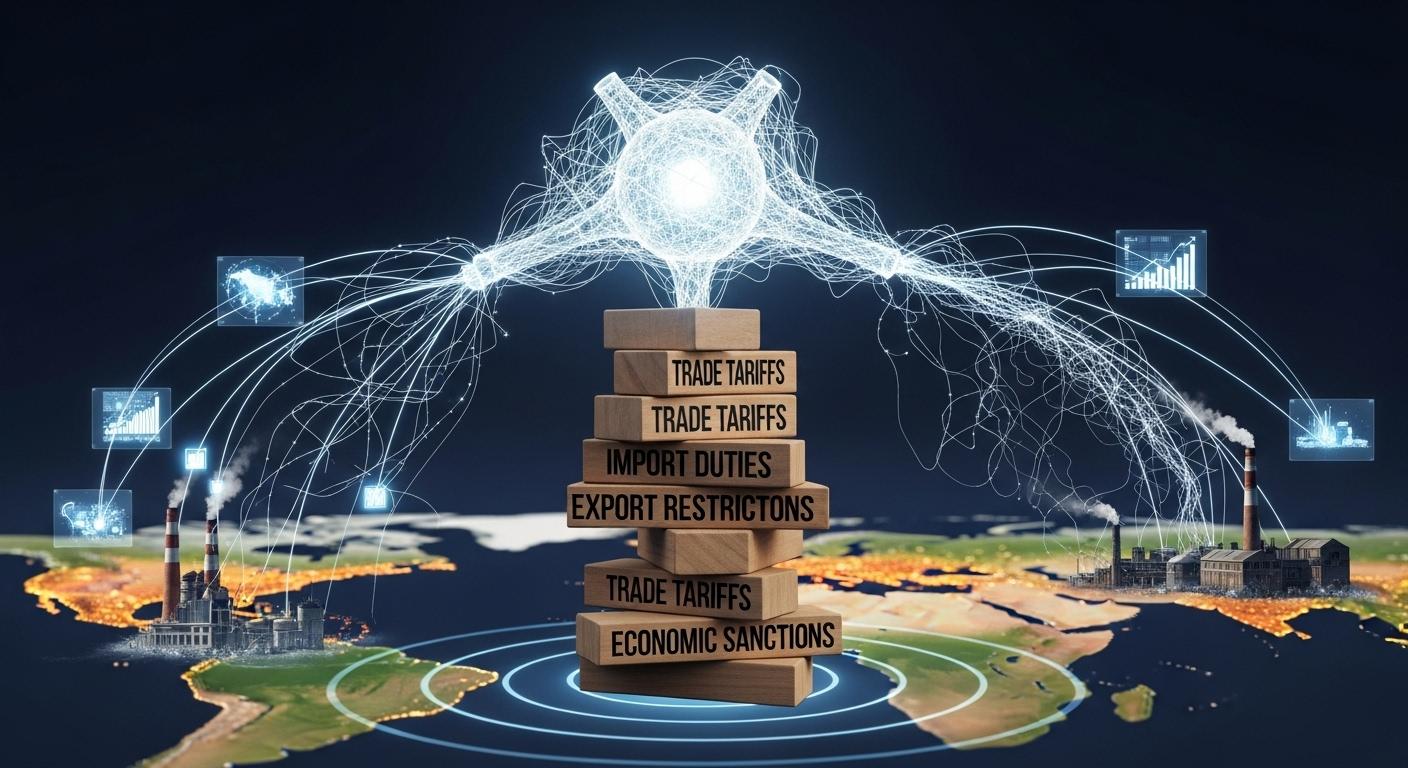
The Trump administration’s sweeping tariff campaign and the rapid expansion of artificial intelligence together rewired the governance, risk and compliance landscape in 2025, forcing boards, legal teams and compliance officers to treat geopolitical and technological volatility as permanent conditions rather than episodic crises. According to the original report, tariffs imposed this year amounted to an average tax increase of $1,200 per US household and sent federal tariff revenue to $195 billion in fiscal 2025, while companies across sectors scrambled to reassess supply chains, disclosure practices and financial reporting under rapidly shifting rules. [1]
The macroeconomic picture reinforced those corporate anxieties. Economists and financial institutions warned of broader economic drag: a survey of CEOs suggested substantial job cuts in retail, wholesale and manufacturing, and forecasts pointed to slower GDP growth and higher consumer prices into 2026. Industry analysis projects large negative impacts on growth and inflationary pressure that will feed directly into corporate risk models and stress tests. According to the related analysis, tariffs could lower U.S. GDP, raise prices materially and generate hundreds of billions in annual tariff revenue, effects that ripple through hiring, sourcing and long‑term planning. [2][3][4]
At the operational level, compliance functions moved from back‑office specialists to central strategic actors. The original report describes how legal and compliance teams worked alongside CFOs and logistics officers to evaluate exposure, source alternatives and navigate novel disclosure and reporting complications. Enforcement also hardened: the Justice Department reorganised to prioritise criminal prosecutions of trade and customs fraud, heightening the risk that misclassification, transshipment or country‑of‑origin errors could trigger civil and criminal exposure under statutes including the False Claims Act and wire fraud provisions. [1]
The legal terrain remained unsettled, with key court decisions and pending litigation set to reshape the landscape. The lead analysis flagged Learning Resources v. Trump as a potential inflection point if the Supreme Court finds IEEPA‑based tariffs unconstitutional, prompting questions about refunds, alternative legal justifications and future tariff design. Observers told CCI that, regardless of eventual judicial outcomes, the immediate practical effect for companies is greater volatility and more frequent emergency actions, reciprocal measures and legal challenges. [1]
Parallel to trade disruption, AI adoption surged and introduced its own, distinct set of governance challenges. Industry data shows nearly nine in ten companies now use AI in at least one business function, and large technology firms poured hundreds of billions into AI infrastructure, even as studies suggested most internal projects are yet to deliver measurable returns. According to the original report, workplace decisions, cyber‑threat evolution, and regulatory fragmentation are driving compliance teams to create multidisciplinary AI governance that keeps humans “in the loop” at the right places while accepting imperfect, iterative learning curves. [1]
The proliferation of AI also sharpened threat models: adversaries weaponised agentic systems to automate polymorphic malware and highly personalised phishing, and experts predicted at least one major AI‑enabled breach the following year. The report quoted practitioners urging education, red‑team testing and a risk‑lifecycle approach that aligns boards, compliance officers and investigators: “Ultimately, AI governance succeeds only when each role operates at the right altitude: the board overseeing strategy and enterprise exposure, the [chief compliance officer] building systems and guardrails and investigators applying those controls in the field while feeding back real‑world intelligence,” two lawyers told CCI. [1]
Corporate enforcement posture shifted in other fields as well. The FCPA review and pause ordered in February prompted recalibration rather than retreat: experts warned against dismantling anti‑bribery programmes, noting that foreign and state regulators, particularly the UK’s SFO and several US states, are prepared to prosecute aggressively. The Justice Department’s revised corporate enforcement and voluntary self‑disclosure policy created a “clear path to declination” for compliant self‑reporters and introduced “near‑miss” benefits, but practitioners remain cautious about relying on promised certainty given residual discretionary factors and collateral consequences. Industry commentary characterised the new federal posture as more selective but potentially more politically salient when cases proceed. [1][5]
Other regulatory shifts compounded compliance complexity. Treasury’s narrowing of CTA application to foreign entities, the DOJ’s expansive data security programme applying national‑security controls to broad classes of personal data, and aggressive moves against corporate DEI programmes all forced compliance teams to prioritise mapping, remediating and documenting risk across multiple jurisdictions and regulatory regimes. The original report and contemporaneous analysis emphasise that pullbacks in one federal area do not eliminate risk but often shift it to states, foreign authorities or private litigation, leaving firms to balance reputational, operational and legal trade‑offs in a more fragmented enforcement environment. [1]
📌 Reference Map:
##Reference Map:
- [1] (Corporate Compliance Insights) - Paragraph 1, Paragraph 3, Paragraph 4, Paragraph 5, Paragraph 6, Paragraph 7, Paragraph 8, Paragraph 9
- [2] (CNBC) - Paragraph 2
- [3] (CNBC / Morgan Stanley) - Paragraph 2
- [4] (CSIS / UC Santa Barbara) - Paragraph 2
- [5] (Vinson & Elkins / V&E Insight) - Paragraph 7
Source: Noah Wire Services