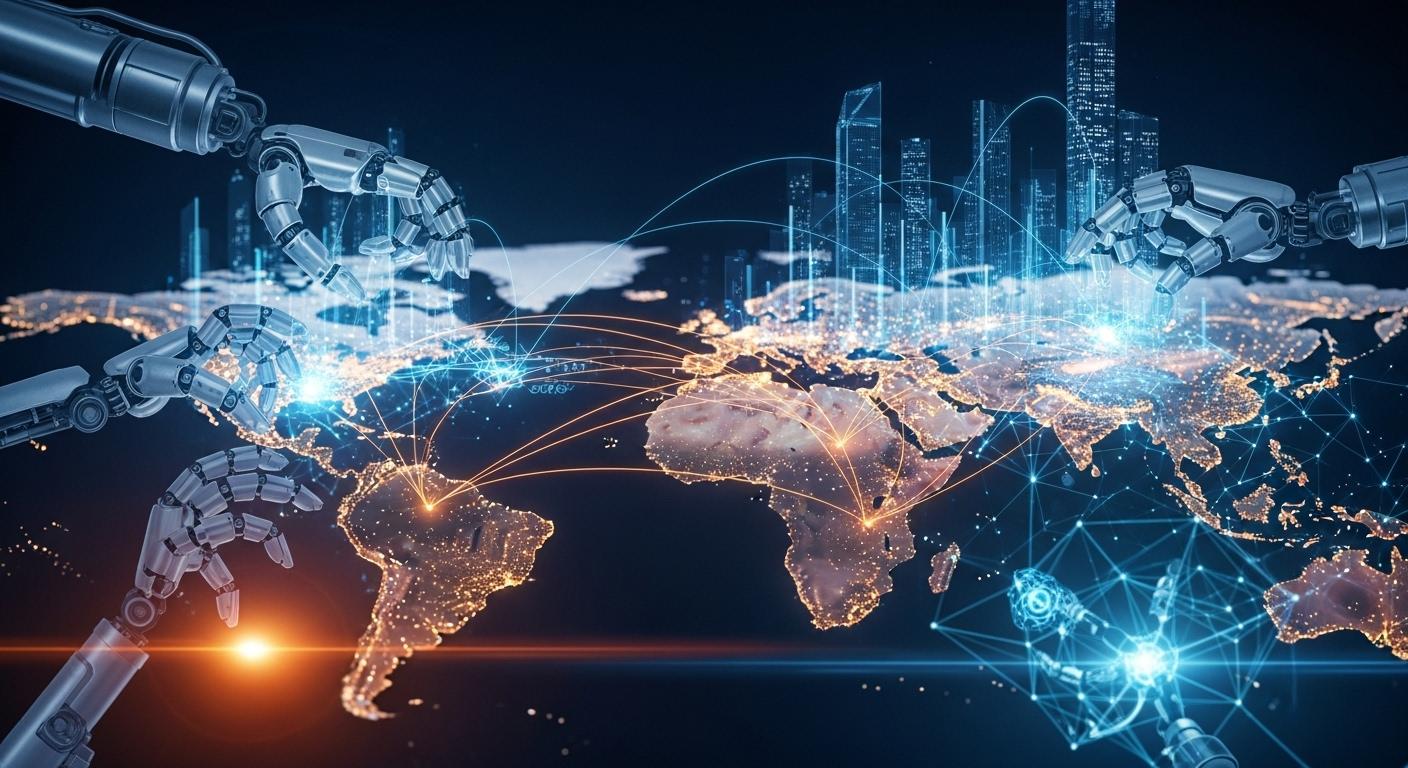
Global markets have been reshaped this year by a potent mix of tariff moves, geopolitical tensions and the rapid diffusion of artificial intelligence, prompting investors to rethink exposures from large-cap technology to resource and financial sectors. According to the lead analysis by Kalkine Media, these themes have driven shifts in sentiment across equities, commodities and currencies, with the ASX functioning as a useful local barometer of how policy and technology changes translate into investment flows. [1]
Tariff actions and trade policy uncertainty have proved a central influence on corporate planning and investor positioning. The World Trade Organization warned that evolving U.S. tariff policies could subtract from global goods trade in 2025, while the International Monetary Fund has warned higher tariffs will boost inflationary pressure and weigh on growth, underscoring how policy uncertainty alone can erode trade and raise costs for firms. These international assessments reinforce the Kalkine Media argument that tariff measures ripple through shipping, sourcing and margins. [2][3][1]
Longer-term research suggests the effects could be structural rather than transitory. McKinsey analysis finds trade corridors and sourcing patterns are already shifting, and in fragmentation scenarios billions of dollars of potential trade growth could be lost by 2035 if tariffs and geopolitical distance rise substantially. That broader, scenario-based view helps explain why companies are diversifying supply chains and why market participants are increasingly attentive to corridor-level risks. [4]
Empirical trade flows already reflect this reorientation. McKinsey charting of recent years shows rising North American integration , notably stronger U.S.–Mexico and U.S.–Canada trade growth , alongside declines in some traditional China-linked corridors, signalling that firms and countries are actively adjusting where they buy and sell goods. Those shifts amplify the Kalkine Media point that export-heavy industries and logistics-sensitive names face heightened scrutiny. [5][1]
Geopolitical tensions have compounded those trade dynamics by elevating the attractiveness of safe-haven assets and by pressing resource security into investors’ calculus. Kalkine Media notes renewed interest in gold and other precious metals during periods of market stress, while miners and diversified resource majors on the ASX remain widely watched as barometers of global demand. At the same time, countermeasures such as export controls on critical minerals add another layer of supply-side risk. [1][7]
Against this backdrop, artificial intelligence has emerged as a dominant constructive theme, shifting from speculative hype to an operational necessity for many corporates. Industry commentary from CSIS and sector data show unprecedented AI-related capital expenditure in the United States and plans for extensive investment in data centres and cloud infrastructure, helping explain why software leaders and technology adopters , including Australian-listed platforms modernising financial and operational systems , have drawn investor attention. The result is a bifurcation: pockets of concentrated tech leadership coexisting with renewed breadth as capital rotates into financials, materials and industrials. [6][1]
The market rotation towards cyclical and smaller-cap opportunities reflects that recalibration. Kalkine Media highlights how investors are rediscovering financials, energy and mining names as they assess the real-economy implications of trade policy and infrastructure demand. McKinsey’s scenario work and trade-flow data reinforce why industrials and resource producers can gain renewed prominence as global supply chains and investment patterns are reconfigured. [1][4][5]
Macro levers remain decisive. Central bank rate decisions continue to influence equity sentiment through borrowing costs and consumer demand, while election cycles add policy risk that can prompt defensive portfolio positioning. The IMF and WTO commentary point to a narrower margin for error: trade barriers and policy volatility risk higher inflation and slower trade,raising the premium investors demand for clarity on fiscal and regulatory direction. [3][2][1]
For investors the practical lesson is familiar but urgent: diversification, rigorous research and scenario planning matter more when policy and technology are jointly remaking economic relationships. Kalkine Media concludes that adaptability and patient, theme-aware positioning will be key as trade policy, geopolitics and AI continue to interact , a judgement echoed by multilateral agencies and strategic consultancies that warn of material upside and downside in trade outcomes depending on policy choices. [1][2][4]
📌 Reference Map:
##Reference Map:
- [1] (Kalkine Media) - Paragraph 1, Paragraph 2, Paragraph 5, Paragraph 6, Paragraph 8, Paragraph 9
- [2] (AP News - WTO report) - Paragraph 2, Paragraph 8
- [3] (AP News - IMF) - Paragraph 2, Paragraph 8
- [4] (McKinsey - A new trade paradigm) - Paragraph 3, Paragraph 7, Paragraph 9
- [5] (McKinsey - Week in charts) - Paragraph 4, Paragraph 7
- [6] (CSIS) - Paragraph 6
- [7] (Odgers Insights) - Paragraph 5
Source: Noah Wire Services