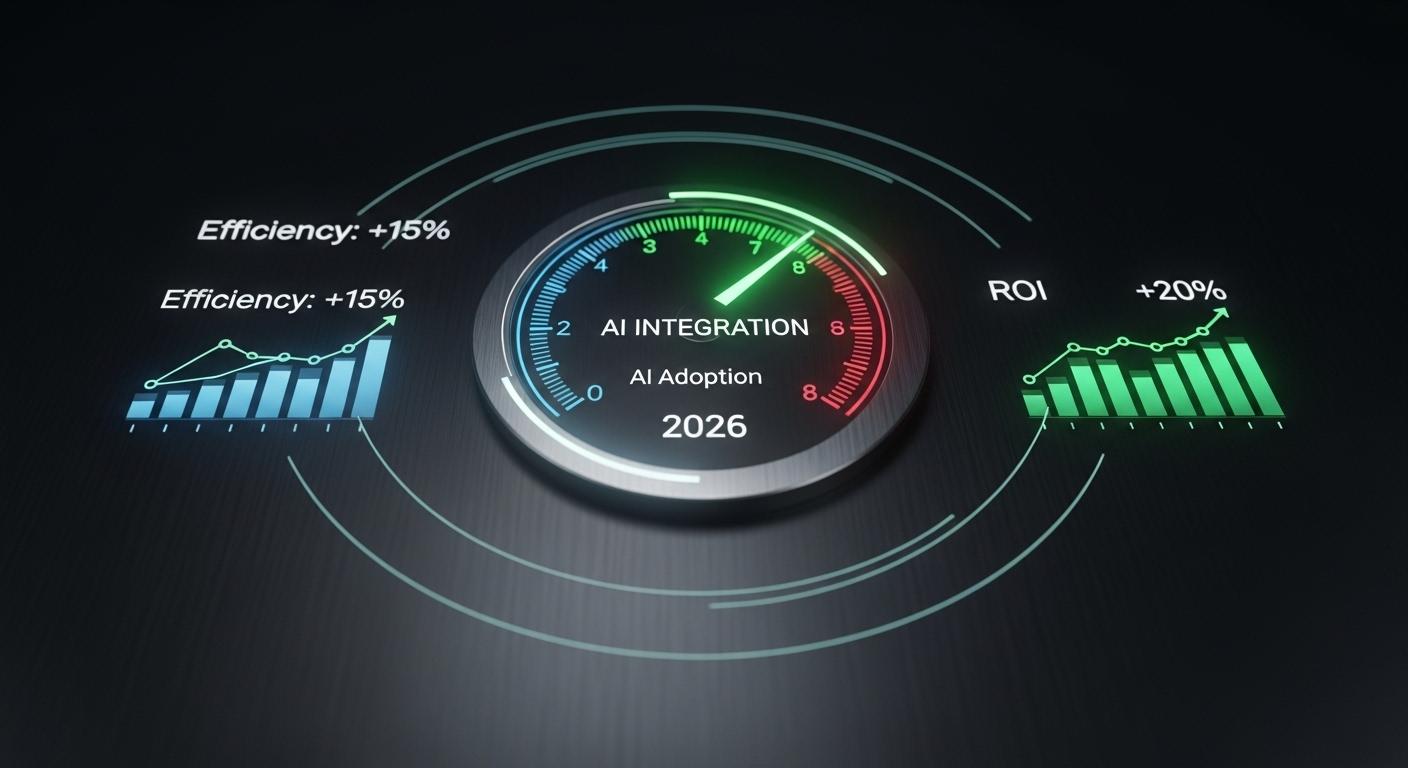
In the opening days of 2026, artificial intelligence has quietly moved from experiment to infrastructure within corporate operations, with businesses prioritising measurable efficiency over headline-grabbing pilots. Reporting and industry commentary indicate that retailers and manufacturers now rely heavily on AI for inventory management and predictive maintenance, while back-office functions increasingly adopt agentic workflows to automate routine decision-making and execution. According to the discussion among MSN reporters, the emphasis has shifted to backend systems that turn data into actionable intelligence, reflecting a broader corporate appetite for verifiable returns rather than novelty. [1]
That shift is being formalised in the market: industry research and surveys show rapid adoption of task-specific agents across enterprise software, with Gartner forecasting a jump toward widespread integration that will convert many productivity tools into platforms for autonomous collaboration and workflow orchestration. Executives, industry analysts and posts on X stress the need for centralised platforms that can orchestrate multiple agents, reduce silos and scale capabilities across the business. This centralisation is presented as a competitive imperative for C-suite leaders. [2][1]
Retail and logistics illustrate the pragmatism behind the trend. A Fluent Commerce study reported by TechRadar finds more than 70% of retailers have piloted or partially deployed agentic AI to improve operational efficiency, especially in customer service, personalised marketing and inventory optimisation, though only a small fraction consider their deployments fully mature. Industry commentary suggests these early wins are prompting greater investment in data pipelines and custom models to support production-grade agents. [3][1]
The business case for agentic systems is echoed in executive surveys: a DeepL study of 5,000 global leaders shows 69% expect AI agents to reshape operations in 2026, citing proven ROI, workforce adaptability and rising enterprise readiness as primary drivers. At the same time, commentary from consultancies and corporate trend reports warns that the pivot from experimentation to scale will be judged on tangible outcomes, with budgets shifting toward projects that demonstrably reduce cost or increase throughput. [4][1]
Back-office functions are among the early beneficiaries of agentic automation; thought leadership and consulting pieces argue that AI agents can transform procurement, compliance, financial reporting and HR by reducing bottlenecks and improving decision speed. McKinsey projections cited in industry analysis estimate large potential economic gains from scaling AI in operations, while Gartner and other forecasters predict substantial increases in mission-critical agent deployments over the next few years. Yet analysts caution that continuous adaptation and governance are required to sustain those gains. [5][1]
The drive to production exposes persistent risks. IBM and Gartner analyses highlight scenarios where insufficient guardrails produce legal, safety and reputational liabilities, warning of a rise in litigation and regulatory scrutiny if accountability structures are not strengthened. In sectors handling safety-critical or sensitive data, such as healthcare and finance, companies are being urged to implement rigorous validation, audit trails and human oversight even as they push agentic systems into live environments. [6][1]
Academic and technical work demonstrates the capabilities and complexity of agentic designs. Research on distributed, multi-role agent architectures , exemplified by an academic proposal for an "agentic open marketplace" for 6G RAN automation , reports substantial performance improvements in throughput and latency when authority is partitioned across specialised agent roles. Such results underline both the promise of agentic approaches for managing complex, dynamic systems and the engineering sophistication required to deploy them at scale. [7][1]
Investment patterns reflect a maturing market: investors and technology leaders are signalling a move away from speculative spending to funding production-grade infrastructure, upskilling and experimentation with verifiable ROI. Industry voices on X and analyst commentary emphasise that firms building robust agentic platforms and data foundations will separate themselves from organisations treating AI as “toys”. At the same time, surveys identify talent shortages, data integration challenges and ethical and regulatory concerns as key barriers to rapid, safe scaling. [1][3][4]
Looking ahead, commentators anticipate the fusion of agentic AI with emerging technologies such as quantum computing and advanced networking will unlock new enterprise use cases in simulation, drug discovery and real-time security. Industry guidance urges leaders to define agent strategies, invest in central platforms and embed responsible innovation to balance innovation with risk management. For many companies, the decisive test of 2026 will be whether they convert pilot promise into operational routines that measurably lift productivity while containing downside exposures. [1][2][6]
📌 Reference Map:
##Reference Map:
- [1] (WebProNews) - Paragraph 1, Paragraph 2, Paragraph 3, Paragraph 4, Paragraph 5, Paragraph 8, Paragraph 9
- [2] (Gartner) - Paragraph 2, Paragraph 9
- [3] (TechRadar/Fluent Commerce) - Paragraph 3, Paragraph 8
- [4] (DeepL/PR Newswire) - Paragraph 4, Paragraph 8
- [5] (Forbes/McKinsey) - Paragraph 5
- [6] (IBM) - Paragraph 6, Paragraph 9
- [7] (arXiv) - Paragraph 7
Source: Noah Wire Services