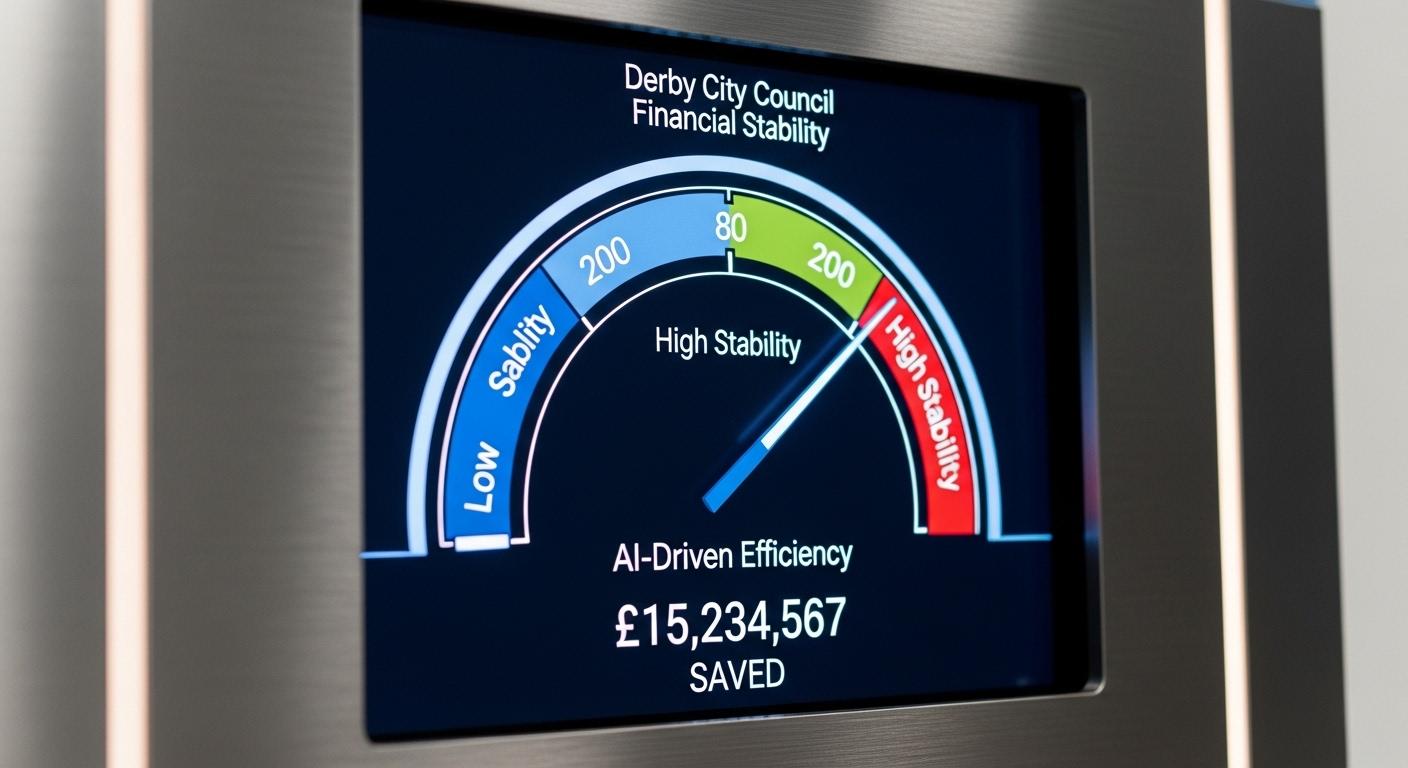
Artificial intelligence has become a central pillar of Derby City Council's bid to stabilise finances and reshape frontline services, delivering what council leaders say are double‑digit millions in savings while prompting debate about the limits of automation in public services.
According to the Derby Telegraph, the council's chief executive Paul Simpson told a budget scrutiny meeting that a council‑developed AI system and digital assistants enabled the authority to remove 100 vacant posts from its budget and realise savings of about £12 million, with further opportunities for savings now being explored. "On the back of analysis, we determined that we could safely take out of the budget 100 posts that at that time were vacant. Therefore, there were no HR implications or redundancy costs or anything else. That saving has been realised," he said. "The £12m (saving) has been delivered. We now have an extra opportunity to save more through AI and that's what we are now exploring." The Derby Telegraph also reported claims the use of AI had "saved it from bankruptcy" amid wider financial pressures facing local authorities.
The council's own reporting shows the AI programme has been rolled out steadily since 2023 and substantially scaled in 2024–25. In March 2025 the authority said its digital assistants Darcie and Ali had handled more than 1.8 million enquiries since introduction, resolving 44% without staff input following a generative AI upgrade. Further upgrades in May 2025 extended Darcie's capabilities to cover a broader range of services and to understand the most widely spoken languages in the city, and by January 2026 the council reported Darcie was resolving 57% of queries directly, reducing telephone queues and freeing staff for complex work.
Council documents and public statements frame the AI roll‑out as a tool to automate routine tasks in areas such as council tax, bin collections, registrations, and some adult social care enquiries, allowing trained staff to focus on higher‑complexity cases. A December 2025 council announcement projected AI would deliver £12.25 million to the medium‑term financial plan by automating repetitive processes across departments including Adult Social Care and Children's Services, while emphasising the technology was intended to protect services rather than replace essential human judgement.
The move has, however, attracted criticism and practical concerns. Councillors and residents have complained at times about difficulties accessing help via digital assistants, with reports the system struggled to understand local dialects and that some elderly residents preferred to speak to a person. Councillor Matthew Holmes, chair of the executive scrutiny board, warned that "AI is not always the answer" and cautioned against losing sight of the council's duty to provide frontline human contact. Councillor Hardyal Dhindsa, the cabinet member for digital transformation, responded that the digital assistants were "becoming more intuitive" and that handling a majority of routine calls represented a "massive saving on demand and pressure on our workforce".
While the council highlights efficiencies and further potential savings, it has also sought to balance automation with inclusion and regeneration priorities. A December 2025 budget proposal linked AI savings to wider plans for a balanced budget and social care investment, and the council has concurrently secured external funding for city regeneration schemes intended to boost local employment and skills. Officials stress upgrades such as multilingual support are designed to reduce access barriers for diverse communities.
Industry observers say Derby's experience illustrates a broader trend among local authorities to use generative AI for demand management amid constrained finances, but they also urge transparency about where automation is deployed and independent evaluation of outcomes. The council itself frames Darcie and Ali as evolving tools: improving resolution rates, reducing waiting times and allowing redeployment of staff, while accepting that some enquiries will always require human intervention.
As the council pursues further AI‑enabled savings and service redesign, the debate in Derby underscores a common tension in public services: the promise of immediate financial relief from automation against the obligation to maintain accessible, person‑centred support for vulnerable residents.
Source Reference Map
- Paragraph 1: [2],[3]
- Paragraph 2: [1]
- Paragraph 3: [5],[4],[6]
- Paragraph 4: [2],[5]
- Paragraph 5: [1],[6]
- Paragraph 6: [3],[7]
- Paragraph 7: [5],[6]
- Paragraph 8: [1],[6]
Source: Noah Wire Services