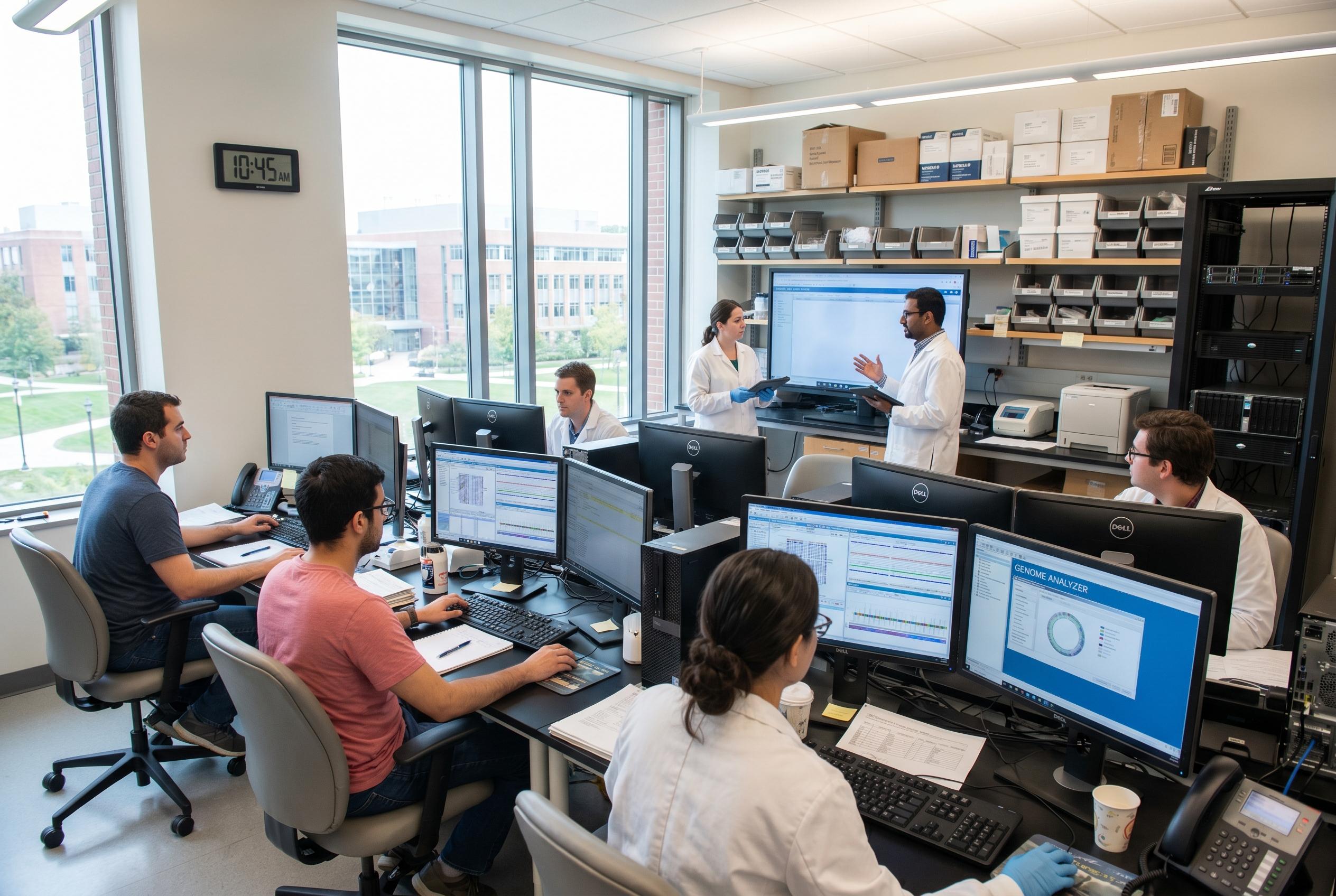
Shoppers of precision diagnostics and lab directors are taking note this Gray May: molecular profiling is now central to diagnosing gliomas, so labs that support CNS cases need repeatable, enterprise workflows to turn complex genomics into clear, clinical answers.
Essential Takeaways
- IDH status matters: testing IDH1/2 is often the first split that defines diffuse glioma pathways and affects prognosis and treatment choices.
- 1p/19q codeletion is decisive: when paired with an IDH mutation it changes classification and clinical expectations, and it has a distinct molecular feel compared with other tumours.
- Multiple variant types required: small variants, copy-number changes, structural rearrangements and promoter methylation are all part of a practical glioma panel.
- Operational repeatability wins: consistent pipelines, shared assessment catalogues and audit trails reduce interpretive drift and speed reporting.
- Enterprise integration helps patients: secure sign-on, APIs to LIS/EHR and a reusable knowledge base make molecular findings clinically actionable and trackable.
Why IDH and 1p/19q still lead the conversation
Start with IDH , it’s the molecular fork in the road for diffuse gliomas and gives you an immediate sense of tumour biology and likely behaviour, often before treatment decisions are final. Pair that with 1p/19q testing and you can separate oligodendroglioma-type biology from other diffuse gliomas, which directly changes diagnosis and prognosis. According to major neuropathology guidance, these markers aren’t optional; they’re classification-defining, so labs need robust assays that reliably call both point mutations and whole-arm codeletions.
Clinically, that means designing an assay strategy up front that captures the common small variants and copy-number signatures. In practice, pathologists report that when those two results are in hand, many downstream questions are easier to answer , you get clarity faster, and clinicians can plan accordingly.
It’s not just substitutions , copy number and fusions matter
Glioma genomes are noisy in different ways: amplifications like EGFR, losses such as CDKN2A/B, and arm-level events (+7/−10) carry as much weight as single-base changes. Add structural events and fusions , for instance FGFR3–TACC3 or the rare but actionable NTRK fusions , and you can see why a multi-modal assay approach is preferable. Labs that rely on small-variant-only panels risk missing alterations that redefine prognosis or unlock targeted therapy options.
So, when choosing or building a workflow, include methods that detect copy-number changes and rearrangements, or combine targeted sequencing with orthogonal assays. That way you’re not surprised by a clinically important event that sits outside a small-variant window.
Where operational problems trip teams up
Running the lab test is necessary but not sufficient; the real bottleneck is consistent interpretation over time and across reviewers. Many groups accumulate knowledge in spreadsheets, PDFs and personal notes, which makes reproducibility fragile. Without controlled pipelines, audit trails and a shared assessment catalogue, decisions can drift and reporting slows.
Enterprise platforms address this by capturing what ran, when, and with which inputs, and by letting teams reuse previous annotations and frequencies. That makes interpretation faster and more consistent, and it reduces the “who did what” headache when cases get tricky or when you need retrospective review for clinical trials or tumour boards.
Practical tips for building a fit-for-purpose CNS workflow
Start with a requirements list: IDH1/2, 1p/19q, ATRX, TP53, TERT promoter, MGMT promoter methylation, EGFR CN, +7/−10 signature, CDKN2A/B, and fusion detection for common glioma partners. Decide which assays will be in-house and which need referral. Validate cross-variant detection and set thresholds for calling copy-number events in FFPE material.
Operationally, codify variant classifications in an assessment catalogue so future cases inherit earlier work. Use role-based access and single sign-on to satisfy governance, and connect your platform to the lab information system so outputs standardise into clinical reports. These steps cut turnaround time and make your genomic evidence more defensible and useful for treating teams.
What this means for patients and tumour boards
When molecular markers drive classification, the lab becomes a clinical partner in a new way: its outputs change labels, prognoses and sometimes treatment paths. For patients that translates into more precise explanations and, increasingly, tailored therapy options. For tumour boards, consistent, reproducible genomic evidence lets multidisciplinary teams make decisions with confidence rather than guessing which assay or note to trust.
Looking ahead, expect more neat examples where a single actionable change , a BRAF V600E in the right setting, an NTRK fusion, or clear CDKN2A/B homozygous loss , converts an ambiguous histology into a clear clinical path. The challenge is organisational: build the workflow so that these findings are found, validated and shared every time.
It's a small change to lab operations that can make every glioma diagnosis clearer and every treatment choice more certain.
Source Reference Map
Story idea inspired by: [1]
Sources by paragraph: