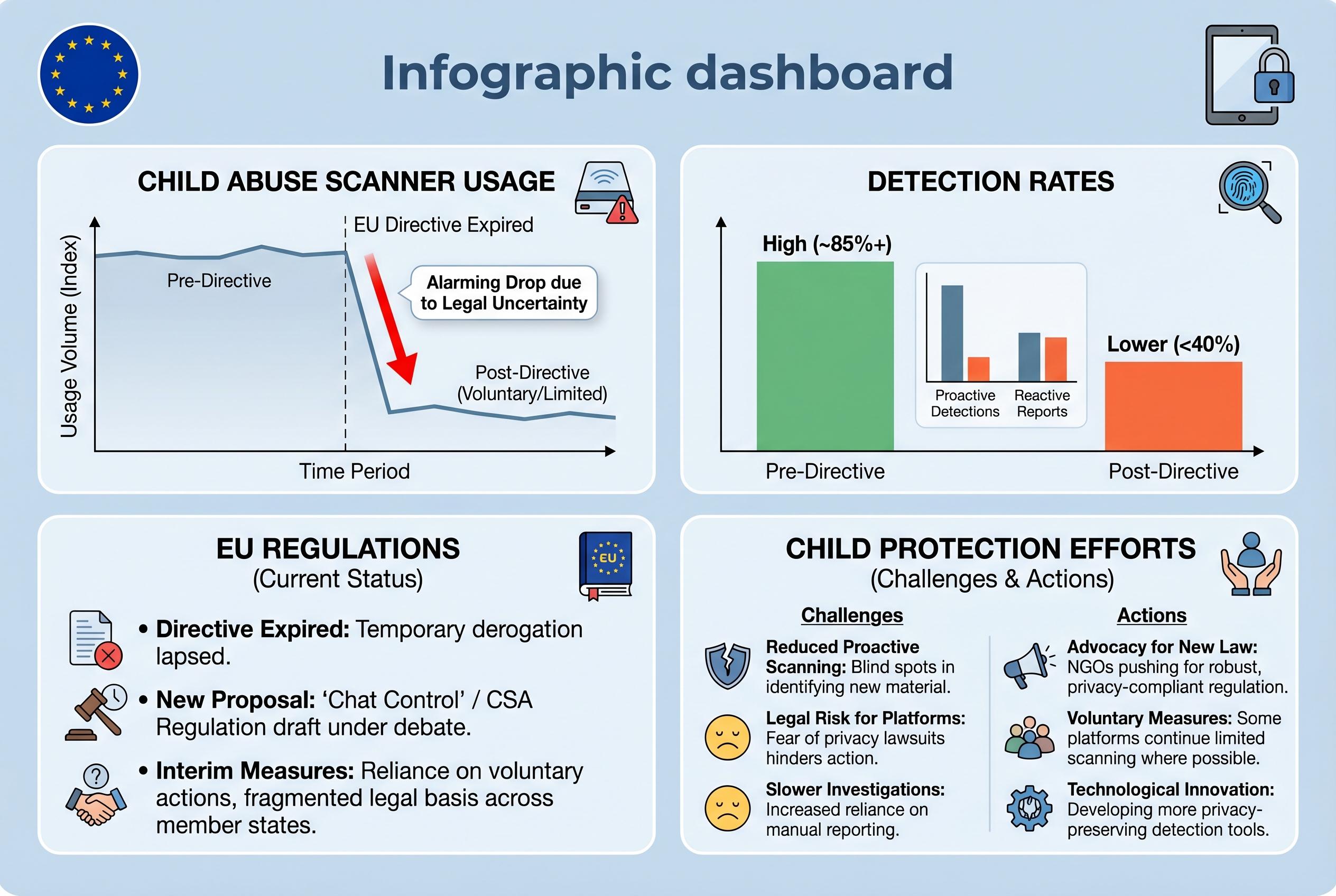
The European Parliament’s refusal to prolong a temporary exemption for scanning child sexual abuse material has opened a legal and political fault-line in Brussels, leaving major technology groups in a difficult position just as child-safety advocates warn that abuse could become harder to detect. The Guardian reported that the carve-out, introduced in 2021 as an interim measure under EU privacy rules, expired on 3 April after lawmakers declined to extend it, despite pressure from child protection organisations and the companies themselves. Google, Meta, Snap and Microsoft said they would keep scanning voluntarily for now, but the broader legal picture has become less certain.
The parliament’s move came after a messy few weeks in which its position shifted. Official European Parliament material shows that on 6 March MEPs backed a short extension of the exemption until August 2027, with safeguards intended to keep the measure targeted and proportionate. But by 27 March, lawmakers had rejected the extension in a vote that ended the chamber’s first reading on the proposal, with 228 in favour, 311 against and 92 abstentions. The result leaves a gap between the old temporary regime and any permanent law, even as negotiations continue on a wider framework to combat online child sexual abuse.
The stakes are high. According to the National Center for Missing and Exploited Children, it received 21.3 million reports in 2025 containing more than 61.8 million suspected abuse files from around the world, and about 90% of those reports related to countries outside the US. Child safety groups say detection tools are crucial because they generate reports that help investigators identify victims and offenders, including in cross-border cases. John Shehan of NCMEC warned that when detection is disrupted, “the abuse doesn’t stop”, a point echoed by advocates who fear the lapse will mean fewer referrals to law enforcement.
Privacy campaigners, however, have long argued that automated scanning of messages risks normalising surveillance and could produce false positives. The European Data Protection Supervisor said in February that any extension had to address weaknesses in the interim regime and avoid indiscriminate scanning, insisting on measures that are targeted and proportionate. The European Parliament has also said it is working on a permanent law, while the Council of the European Union adopted its own position in November 2025 on legislation that would impose duties on platforms to prevent the spread of abuse material and the solicitation of children, and would create an EU Centre on Child Sexual Abuse. For now, though, the temporary compromise has fallen away, and the long-promised replacement is still unfinished.
Source Reference Map
Inspired by headline at: [1]
Sources by paragraph:
Source: Noah Wire Services