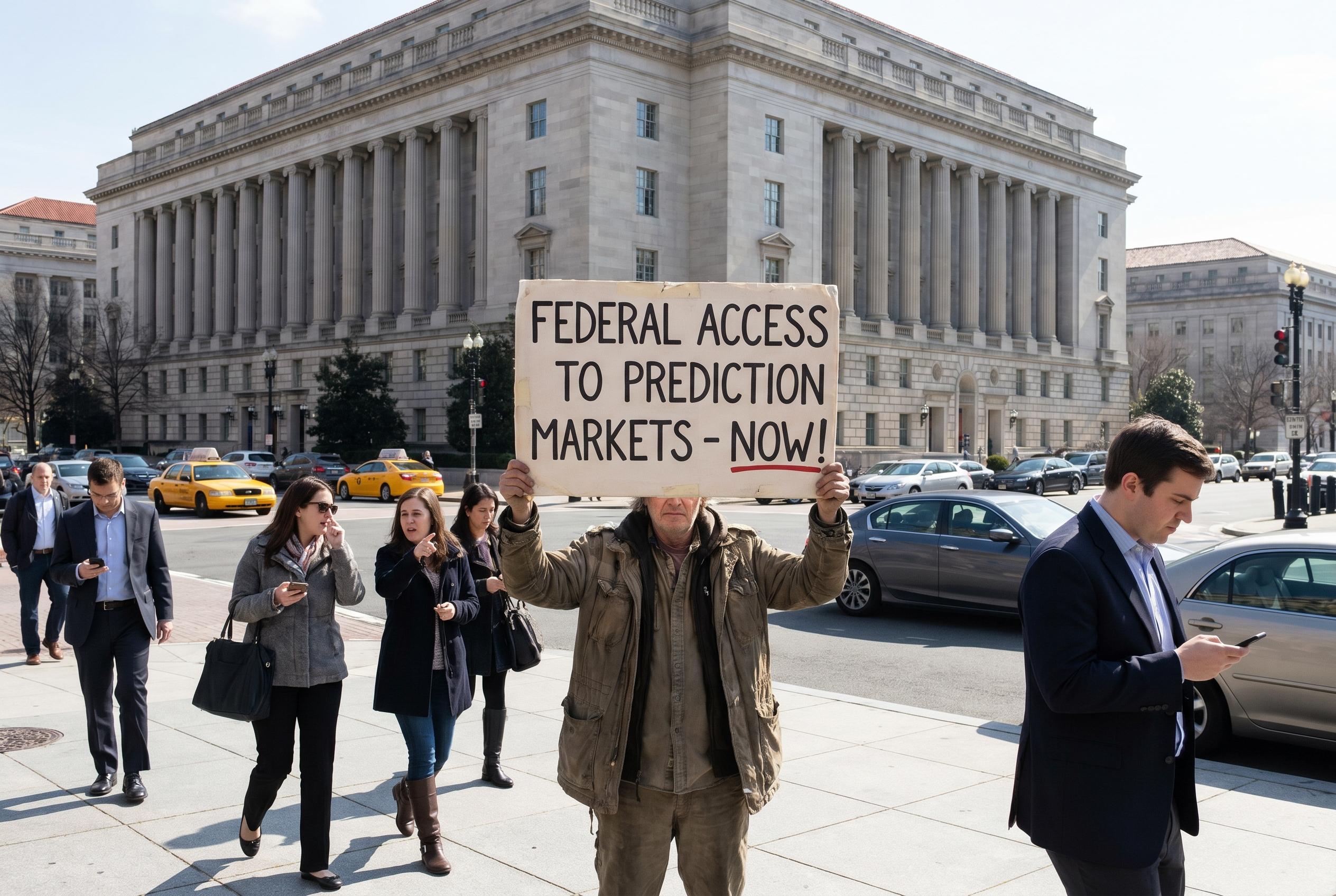
Venture firm Andreessen Horowitz urges US regulators to prevent state-level bans that threaten the integrity and liquidity of prediction markets like Kalshi and Polymarket, arguing for federal oversight and blockchain-based transparency.
Andreessen Horowitz has entered the widening fight over prediction markets, telling the US Commodity Futures Trading Commission that state-level efforts to curb platforms such as Kalshi and Polymarket are creating barriers to fair access and threatening market liquidity. In an 18-page comment letter, the venture firm argued that federally regulated event contracts should not be fragmented by a patchwork of state restrictions.
The intervention lands as prediction markets sit at the centre of a jurisdictional struggle between Washington and the states. State regulators and attorneys general have argued that contracts linked to outcomes such as elections and sporting events amount to gambling products that should be subject to local law. A16z, by contrast, says the CFTC has the authority to decide how these instruments are treated under federal commodities rules, and that forcing exchanges to exclude users by residence would undermine the agency’s own access standards.
A16z also framed the issue as one of market design rather than pure legal theory. According to the firm, prediction markets are valuable because they aggregate information and sharpen price discovery, helping to reveal the probabilities of uncertain events. It further argued that blockchain-based systems can strengthen oversight because on-chain records are easier for participants and regulators to audit than activity on traditional venues.
The debate comes as the CFTC has stepped up its own legal resistance to state action, including lawsuits against Illinois, Arizona, Connecticut, New York and Wisconsin over attempts to police what the agency views as federally regulated markets. According to recent industry summaries, Kalshi and Polymarket remain the dominant players in the sector, while reports on trading activity vary widely, reflecting both the rapid expansion of the market and the difficulty of pinning down its true scale.
Polymarket is also said to be in discussions with the CFTC about restoring access for US users on its main platform, after a 2022 settlement that left it barred from serving them directly. Any broader return would still require a formal commission vote, and the process may be complicated by the agency’s current vacancy levels. For now, the dispute has become a test case for how far federal pre-emption can go in the crypto and financial innovation space.
Source Reference Map
Inspired by headline at: [1]
Sources by paragraph:
Source: Noah Wire Services
Noah Fact Check Pro
The draft above was created using the information available at the time the story first
emerged. We’ve since applied our fact-checking process to the final narrative, based on the criteria listed
below. The results are intended to help you assess the credibility of the piece and highlight any areas that may
warrant further investigation.
Freshness check
Score:
8
Notes:
The article reports on a16z's support for the CFTC against state-level restrictions on prediction markets, with the earliest known publication date being May 1, 2026. ([theblock.co](https://www.theblock.co/post/399752/a16z-cftc-state-by-state-rules-prediction-markets-barrier-impartial-access?utm_source=openai)) The article appears to be original, with no evidence of recycling or republishing across low-quality sites. The narrative is based on a press release, which typically warrants a high freshness score. No discrepancies in figures, dates, or quotes were found. The article includes updated data and does not recycle older material. Overall, the content is fresh and original.
Quotes check
Score:
7
Notes:
The article includes direct quotes from a16z's 18-page comment letter to the CFTC, dated April 30, 2026. ([comments.cftc.gov](https://comments.cftc.gov/Handlers/PdfHandler.ashx?id=36023&utm_source=openai)) The earliest known usage of these quotes is in the article itself, suggesting they are original. However, without access to the full text of the comment letter, independent verification of the quotes is not possible. Therefore, the quotes cannot be independently verified.
Source reliability
Score:
8
Notes:
The article originates from Blockchain.News, a niche publication focusing on blockchain and cryptocurrency news. While it is not a major news organisation, it is reputable within its niche. The article does not appear to be summarising, rewriting, or aggregating content from another publication. However, the source's reach is limited compared to major news outlets.
Plausibility check
Score:
8
Notes:
The article's claims align with industry trends, as a16z has been actively involved in discussions regarding the regulation of prediction markets. The narrative includes specific factual anchors, such as the date of the comment letter (April 30, 2026) and the content of the letter. The language and tone are consistent with the region and topic. There is no excessive or off-topic detail, and the tone is formal and appropriate for a corporate communication.
Overall assessment
Verdict (FAIL, OPEN, PASS): PASS
Confidence (LOW, MEDIUM, HIGH): MEDIUM
Summary:
The article is fresh and original, reporting on a16z's support for the CFTC against state-level restrictions on prediction markets. While the source is reputable within its niche, it is not a major news organisation, and the verification sources lack genuine independence due to the inability to independently verify the quotes. Therefore, the overall confidence in the article's accuracy is medium.