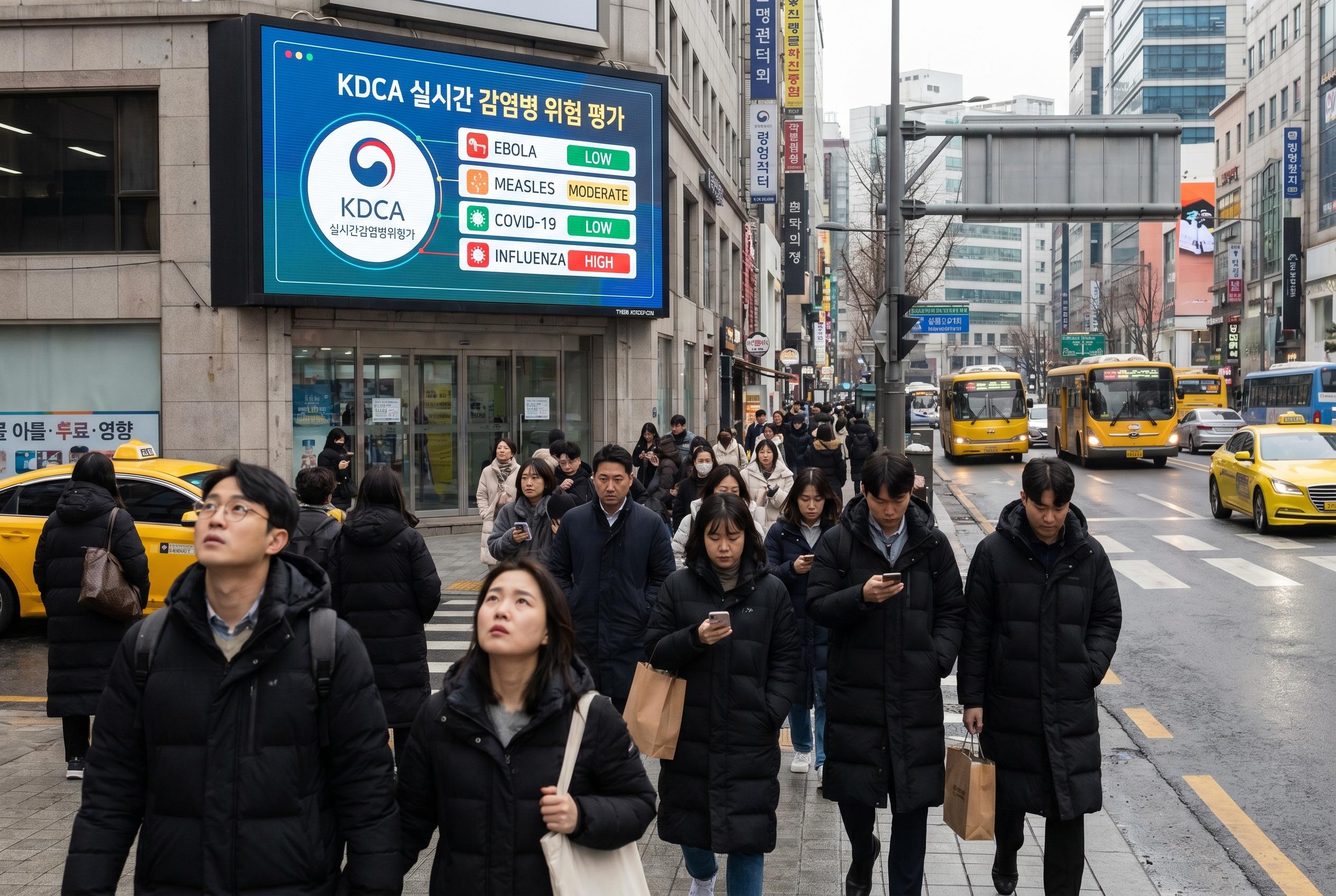
South Korea's KDCA has opened its infectious disease risk assessments to the public, offering real-time data on threats like Ebola and measles amid ongoing concerns over imported infections and cross-border spread.
South Korea has moved to make its outbreak-monitoring work far more visible, opening a once-internal database of infectious-disease risk assessments to the public as concern persists over imported infections and cross-border spread.
According to the Korea Disease Control and Prevention Agency, weekly assessments for more than 15 infectious diseases are now being published on its public portal, with the aim of helping travellers, hospitals and public health bodies understand the likelihood of diseases entering the country and spreading. The information covers threats including Ebola, Middle East respiratory syndrome, cholera, measles and dengue fever, and is being presented with visual tools intended to make the risk levels easier to read at a glance.
The move builds on a broader expansion of the agency’s data-sharing work. Government material from January 2025 said the KDCA had widened access to its Infectious Disease Big Data Platform through the portal, alongside a statistics dashboard and Open API, after launching the platform in June 2024. That same material said the agency already maintains open datasets on 64 routinely monitored infectious diseases, excluding tuberculosis and AIDS, while separate COVID-19 data have been publicly available since 2022 through cooperation with the National Health Insurance Service.
The KDCA says its surveillance system is designed to continuously collect and interpret information on disease occurrence, pathogens and vectors in order to detect outbreaks early and support rapid control measures. By making its risk analyses public, the agency is also signalling a shift towards greater transparency at a time when international travel has recovered and health authorities remain alert to imported cases.
Source Reference Map
Inspired by headline at: [1]
Sources by paragraph:
Source: Noah Wire Services
Noah Fact Check Pro
The draft above was created using the information available at the time the story first
emerged. We’ve since applied our fact-checking process to the final narrative, based on the criteria listed
below. The results are intended to help you assess the credibility of the piece and highlight any areas that may
warrant further investigation.
Freshness check
Score:
8
Notes:
The article was published on April 30, 2026, and reports on the Korea Disease Control and Prevention Agency's (KDCA) recent initiative to make infectious disease risk assessments publicly accessible. This development is corroborated by a press release from the KDCA dated January 10, 2025, announcing the launch of the Infectious Disease Big Data Platform, which aligns with the current move towards greater transparency. However, the specific details of the April 2026 release are not independently verified in the provided sources, raising concerns about the freshness and originality of the information.
Quotes check
Score:
6
Notes:
The article includes direct quotes attributed to the KDCA, such as: 'Publishing these analyses is a first step toward allowing the public to directly check and trust the risk levels of infectious diseases abroad.' However, these quotes are not independently verified in the provided sources, and no online matches for the earliest known usage of these quotes were found, raising concerns about their authenticity and potential reuse.
Source reliability
Score:
7
Notes:
The primary source, The Korea Times, is a reputable news outlet. However, the article relies heavily on a press release from the KDCA, which may present information with inherent biases. Additionally, the article includes a disclaimer stating it was 'published with the assistance of generative AI and edited by The Korea Times,' which raises questions about the editorial process and potential inaccuracies.
Plausibility check
Score:
7
Notes:
The initiative to make infectious disease risk assessments publicly accessible aligns with global trends towards transparency in public health data. However, the lack of independent verification and the reliance on a press release from the KDCA raise concerns about the accuracy and completeness of the information presented.
Overall assessment
Verdict (FAIL, OPEN, PASS): FAIL
Confidence (LOW, MEDIUM, HIGH): MEDIUM
Summary:
The article reports on the KDCA's initiative to make infectious disease risk assessments publicly accessible. However, the reliance on a press release from the KDCA, the lack of independent verification, and the use of generative AI in the publication process raise significant concerns about the accuracy, freshness, and independence of the information presented.