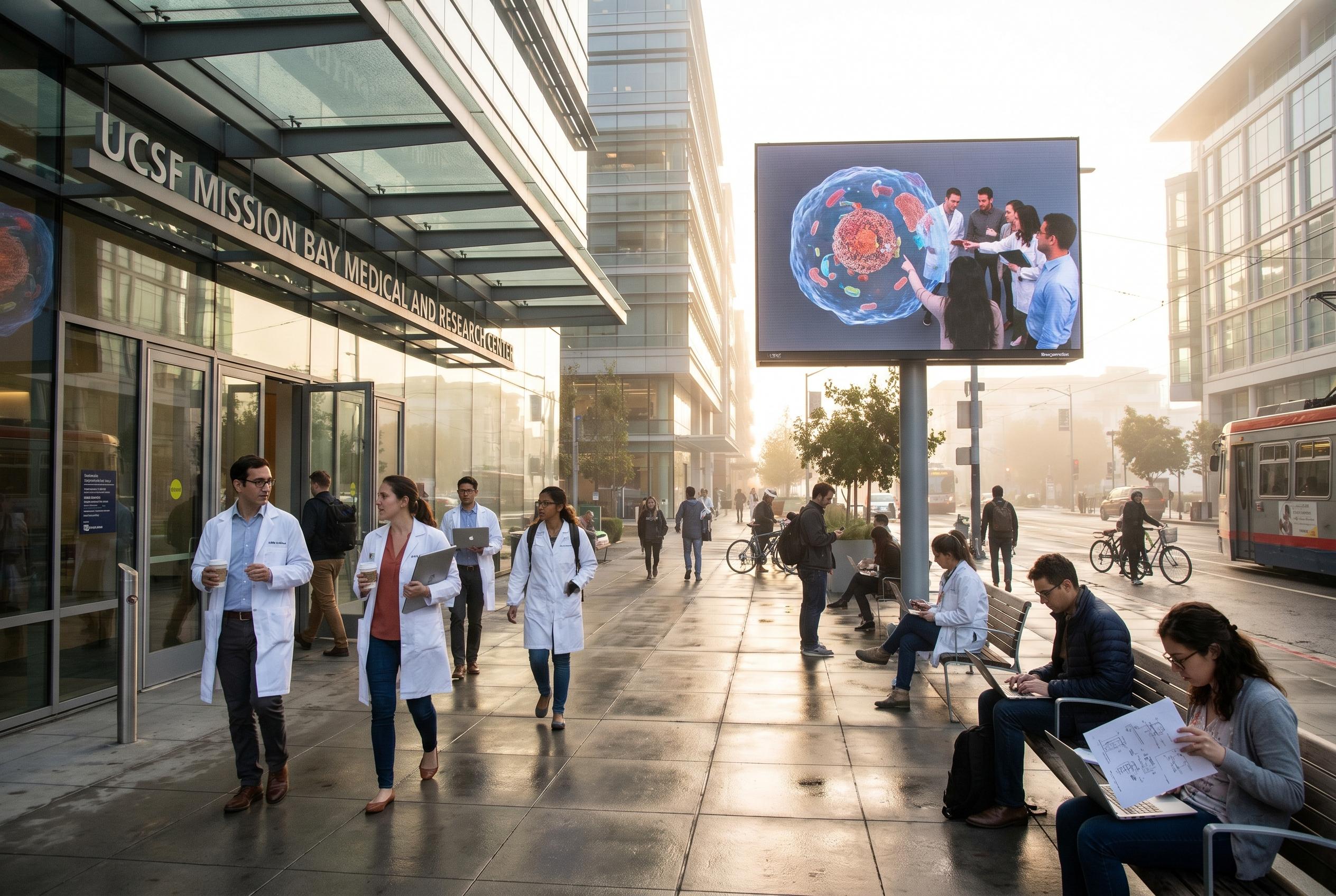
Shoppers of science are watching closely: Biohub is investing $500 million to build AI models of human cells, teaming with Nvidia and top labs to speed up disease research and drug discovery , a bold, open-data push that could reshape how we study health and cure illness.
Essential Takeaways
- Big-money backing: Biohub will spend $500m over five years on AI-driven human cell models, with $100m earmarked for external researchers.
- Open science promise: Data and models are set to be shared broadly, aiming to fuel global collaboration and reproducibility.
- Tech partners: Nvidia and other platform players provide compute and software; scalable infrastructure is a core focus.
- Practical payoff: If accurate, models could predict cell behaviour in health and disease, speeding up target identification and testing.
- Uncertain scale: Scientists say vastly more data is needed; the right volume and diversity of cellular data remain open questions.
Why Biohub thinks AI can model a cell , and why that matters
Biohub argues that training AI on massive, high-quality cellular datasets will let researchers simulate how cells behave across health and disease, revealing mechanisms you simply can’t see with traditional lab work. The pitch is visceral: imagine a digital cell that reacts to a drug or infection in silico before a lab dish is touched, saving time and animals, and cutting years from research programmes. According to Biohub’s leaders, this is less pie-in-the-sky and more a scaling problem , give models more diverse biological data and they’ll get more useful.
That logic sits alongside a wider shift in biomedicine toward computational-first discovery. Industry players from DeepMind to Isomorphic Labs are already probing these waters, and Biohub’s move amplifies the idea that biology can be observed, measured and ultimately programmed at scale. For patients and funders, the appeal is obvious: faster hypotheses, fewer dead ends and, hopefully, quicker routes to treatments.
How the money will be split and why external grants matter
Of the $500m pledge, about $400m will fund Biohub’s internal work while $100m is set aside for external researchers and partners. That’s a notable design choice , it signals a desire to build community capacity rather than hoard models behind a single lab. External grants can help broaden the data sources and test models on varied problems, which is precisely what model builders say they need.
Open funding also invites smaller teams and international labs into the loop, which increases the diversity of biological contexts the models see. That diversity is practical: cells in one tissue or population can behave very differently from those elsewhere, and model robustness depends on sampling that variation.
Partnerships and compute: why Nvidia and scale are central
AI biology isn’t just about clever algorithms; it’s a compute race too. Biohub’s collaboration with Nvidia and other technology partners provides the raw horsepower and specialised tools needed to train enormous models on terabytes or petabytes of cellular data. Nvidia’s BioNeMo and similar platforms are already used by biotech firms to design therapies, so linking that infrastructure to an open-data initiative could accelerate uptake across industry and academia.
Still, hardware alone won’t guarantee success. Model quality depends on experimental design, metadata standards and interoperability , the boring but crucial plumbing that makes datasets useful. Biohub’s bet is that combining compute, good data practices and open sharing will create a virtuous cycle.
Open data, ethical questions and the need for global cooperation
Biohub has pledged to make its datasets and tools openly available, a move that invites collaboration but also raises governance questions. Who controls access, how are privacy and consent handled for human-derived samples, and how do we ensure fair use across countries? Biohub acknowledges these hurdles and says international cooperation will be essential to reach the scale needed for reliable models.
There’s also a cultural shift at work: labs used to guarding data must learn to standardise and share, while funders and journals must reward reproducible, collaborative work. If Biohub can nudge those norms, the impact could extend beyond one project , it might change how biomedical science is organised.
What this means for drug discovery and patients in the near term
In the short run, expect incremental gains rather than instant cures. AI cell models that flag promising drug targets, predict toxicities or prioritise experiments will shave months or years off specific development paths. For clinicians and patients, that translates into a steadier flow of better-tested candidates and fewer late-stage failures.
Longer term, if models reach high fidelity across tissues and disease states, they could reframe prevention and personalised medicine by predicting how an individual’s cells might respond to exposures or therapies. That’s a big if, but Biohub’s combination of funding, partnerships and openness makes it one of the better-funded attempts to find out.
Closing line It’s an ambitious play, but making cell biology virtual , and open , could be a small change with a big ripple across how we discover and deliver treatments.
Source Reference Map
Story idea inspired by: [1]
Sources by paragraph: