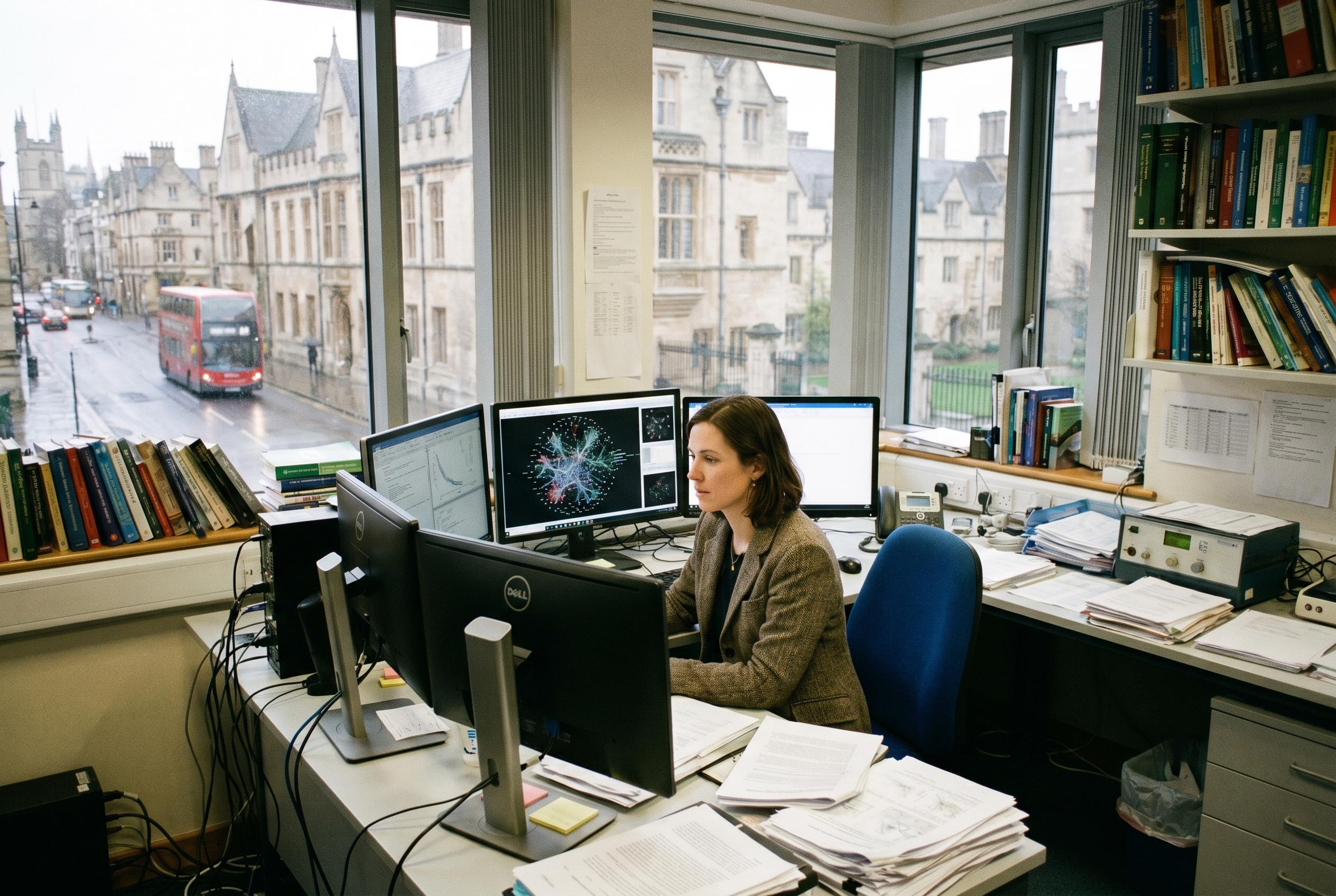
Shoppers of scientific data are now spoilt for choice: OpenBind, a UK-led consortium, has published its first AI-ready dataset and model, giving researchers high-quality protein–ligand binding data that could speed up drug discovery and help tackle global health priorities. This matters because clean, standardised experimental data is exactly what machine learning needs to make better medicines faster.
Essential Takeaways
- High-resolution detail: OpenBind couples X-ray crystallography snapshots with quantitative binding assays, delivering atomic-level protein–ligand views that feel precise and machine-friendly.
- Fast scale-up: In seven months the platform generated over 800 binding measurements, showing automation can compress years of work into months.
- AI-ready standards: Metadata and reproducible workflows were built from day one, so the dataset plugs into machine-learning pipelines with minimal cleaning.
- Collaborative muscle: Led by Diamond Light Source with UK government backing, OpenBind brings structural biology, automated chemistry and ML teams together.
- Open science ethos: Data and an inaugural predictive model are publicly released to democratise drug-design tools worldwide.
Why this dataset is different , and why you’ll notice the detail
OpenBind’s first release reads like a tidy lab notebook made for a neural network, with crisp experimental metadata and atomic snapshots that actually map where fragments sit on a protein. According to Diamond Light Source, the project merges high-throughput X-ray crystallography with standardised binding assays, so the output isn’t a random pile of files but a consistent resource. That consistency matters: models hate messy data, and reliable inputs often mean the difference between a usable prediction and noise.
The initiative’s industrial-style pipeline is the practical answer to a long-standing complaint from model builders , years of experimental variability. By designing workflows that prioritise reproducibility, OpenBind reduces the time researchers spend cleaning data and increases the chance that machine learning will learn genuine chemistry signals rather than artefacts.
How automation squeezed months into what once took years
OpenBind’s tempo is striking: more than 800 binding measurements in seven months. That speed comes from automation across the board , from fragment soaking and X-ray collection to downstream data handling , all orchestrated at Diamond’s XChem facility. Rapid cycles let teams iterate: try a fragment, measure binding, feed data to a model, update chemistry. It’s a feedback loop that used to be aspirational and is now operational.
This kind of throughput also means researchers can test wider chemical space faster. If you’re a medicinal chemist, that translates to more ideas validated in the lab before you commit to costly optimisation. And for public-health projects , think antivirals or neglected-disease targets , speed can be the difference between a pipeline and a paused promise.
Why AI models will benefit , and what still matters
Professor Mohammed Alquraishi and other experts have noted that protein-structure advances like AlphaFold2 shifted expectations for AI, but the missing piece has been abundant, high-quality protein–drug complex data. OpenBind supplies that missing training material. By aligning experimental design to machine-learning needs, the dataset should help models distinguish subtle features that influence binding affinity and specificity.
Still, quantity alone won’t solve every modelling headache. Diverse targets, richer chemical libraries and longer-term datasets will be necessary to build broadly generalisable models. OpenBind’s roadmap contemplates those expansions, and planned community blind challenges will be essential to validate whether models trained on this resource genuinely generalise to new experiments.
Practical tips for researchers and teams wanting to use OpenBind
If you plan to plug this dataset into your workflow, start by checking the metadata schema: standardised fields mean you can automate ingestion. Use the structural snapshots alongside the quantitative binding values , combining geometry and numbers is where predictive power lives. For model builders, consider transfer learning on similar targets before attempting full generalisation, and participate in OpenBind’s community challenges to benchmark approaches.
For labs with limited infrastructure, the openness of the release matters: you can build models locally or collaborate with groups that run larger compute, confident that the source data has been curated to industry-style standards.
What’s next , expansion, validation and public-good goals
OpenBind isn’t stopping at this inaugural release. The consortium aims to widen its target list, enrich chemical diversity, and deepen binding datasets , all crucial for models to improve. The group also plans regular, community-facing validation exercises so outsiders can test predictions against newly generated data, a practice that will keep the field honest and spur methodological progress.
Strategically, the initiative maps onto global health needs by prioritising targets like viral pathogens and diseases prevalent in low-resource settings. By opening both data and models, OpenBind also nudges the drug-discovery ecosystem toward more equitable collaboration and faster, more transparent innovation.
It's a small change with big implications: better data makes better AI, and better AI makes faster paths to new medicines.
Source Reference Map
Story idea inspired by: [1]
Sources by paragraph: