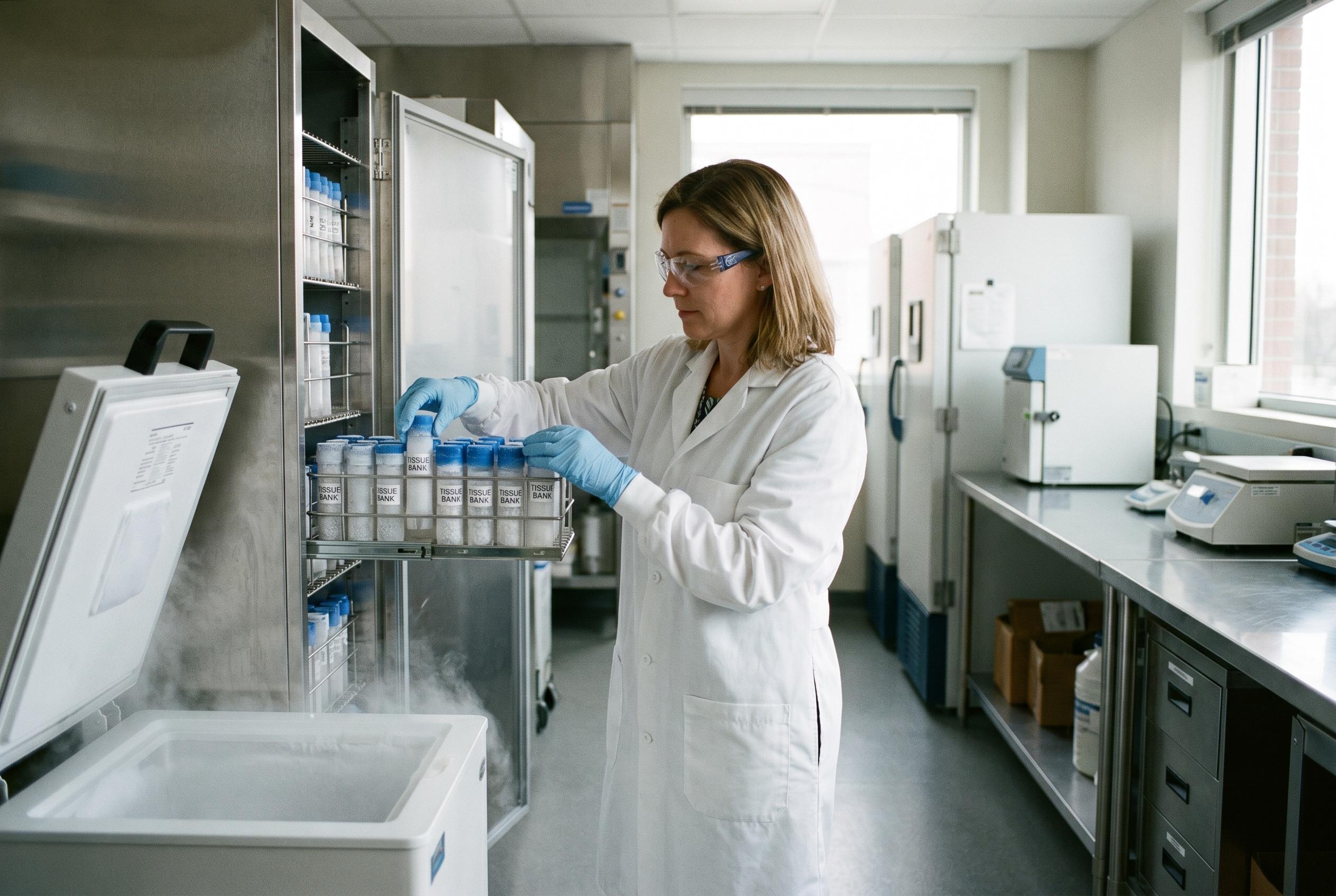
Shoppers and investors are eyeing tissue banking as a growth story: demand for preserved human tissues is rising across hospitals, research labs and biopharma, and that matters because better storage equals faster therapies, higher transplant success and a stronger regenerative‑medicine pipeline.
Essential Takeaways
- Market size: The tissue banking market is forecast to approach US$3.9 billion by 2031, driven by transplant and regenerative‑medicine demand.
- Growth rate: Analysts expect a compound annual growth rate around 8.4% from 2025–2031.
- Regional leaders: North America leads today; Asia‑Pacific is the fastest‑growing region with expanding healthcare infrastructure.
- Technology push: Cryopreservation improvements, automation and AI tracking are making banks safer and more scalable.
- End users: Hospitals remain the biggest customers, with research institutes and biopharma rapidly increasing their share.
Why tissue banking is suddenly front‑of‑mind for hospitals and investors
Tissue banks quietly anchor modern surgery and regenerative medicine, storing bone, skin, corneas, heart valves and stem cells. The market narrative is simple and sensory , better storage means tissues that look, feel and function closer to native tissue when implanted. According to industry reports, that reliability is turning tissue banking into a clear growth sector for hospital systems and investors. As surgeons attempt more complex reconstructions and companies run more cell‑therapy trials, ready access to high‑quality tissues shortens wait times and improves outcomes.
Regenerative medicine is the engine; stem cells are the fuel
Advances in stem‑cell therapies for orthopaedic, neurological and cardiovascular conditions are a major market driver. Tissue banks supply the raw material researchers and clinicians need, and as trials move into late‑stage development the demand profile shifts from token samples to clinical‑grade inventories. That means banks must meet stricter quality controls and traceability standards, and many are investing in automated cryogenic systems and digital chain‑of‑custody tools to keep pace.
Tech trends: cryopreservation, automation and data tracking
Cryopreservation has leapt forward , better freezing media, controlled‑rate freezers and automated storage are reducing spoilage and contamination. Add AI‑enabled tracking and real‑time monitoring and you get a bank that feels modern: quieter, sleeker and more dependable. For research labs and biopharma, those capabilities matter because consistent sample quality speeds up drug discovery and modelling. Practical tip: when choosing a tissue bank partner, check for ISO certification, validated cold‑chain processes and digital audit trails.
Geography matters: who’s buying and where growth is fastest
North America currently dominates thanks to mature healthcare systems and high transplant rates, but Asia‑Pacific is growing fastest as hospitals expand and medical tourism rises. Europe sits in the middle with steady investment and growing donor awareness. Emerging markets in Latin America and the Middle East are investing selectively, creating opportunities for regional hubs. For policy watchers, that regional shift means regulatory harmonisation and cross‑border transfer rules will be increasingly important.
Ethics, regulation and the human side of banking tissue
Tissue banking operates at the intersection of medicine, ethics and law. Donor consent, privacy and research governance have to be airtight , universities and hospitals are updating guidance and institutional review processes to keep pace. Increased public awareness campaigns and opt‑out systems in some countries are growing donor pools, but they also require robust communication so donors understand how tissues will be used. For clinicians, the message is clear: transparency builds trust, and trust builds supply.
What clinicians, researchers and patients should look for next
Expect consolidation and partnerships: big players in lab supplies and biobanking tech are investing in end‑to‑end solutions, while hospitals form strategic alliances with research centres. For patients and clinicians, that should translate into better access to grafts and more predictable outcomes. If you’re evaluating a tissue bank, prioritise accreditation, temperature‑control redundancies, proven cryoprotectants and partnerships with clinical programmes. And remember the small things , clear consent forms and easy donor support services make a big difference.
It's a small change in infrastructure that can make a big difference to surgical success and the pace of medical research.
Source Reference Map
Story idea inspired by: [1]
Sources by paragraph: