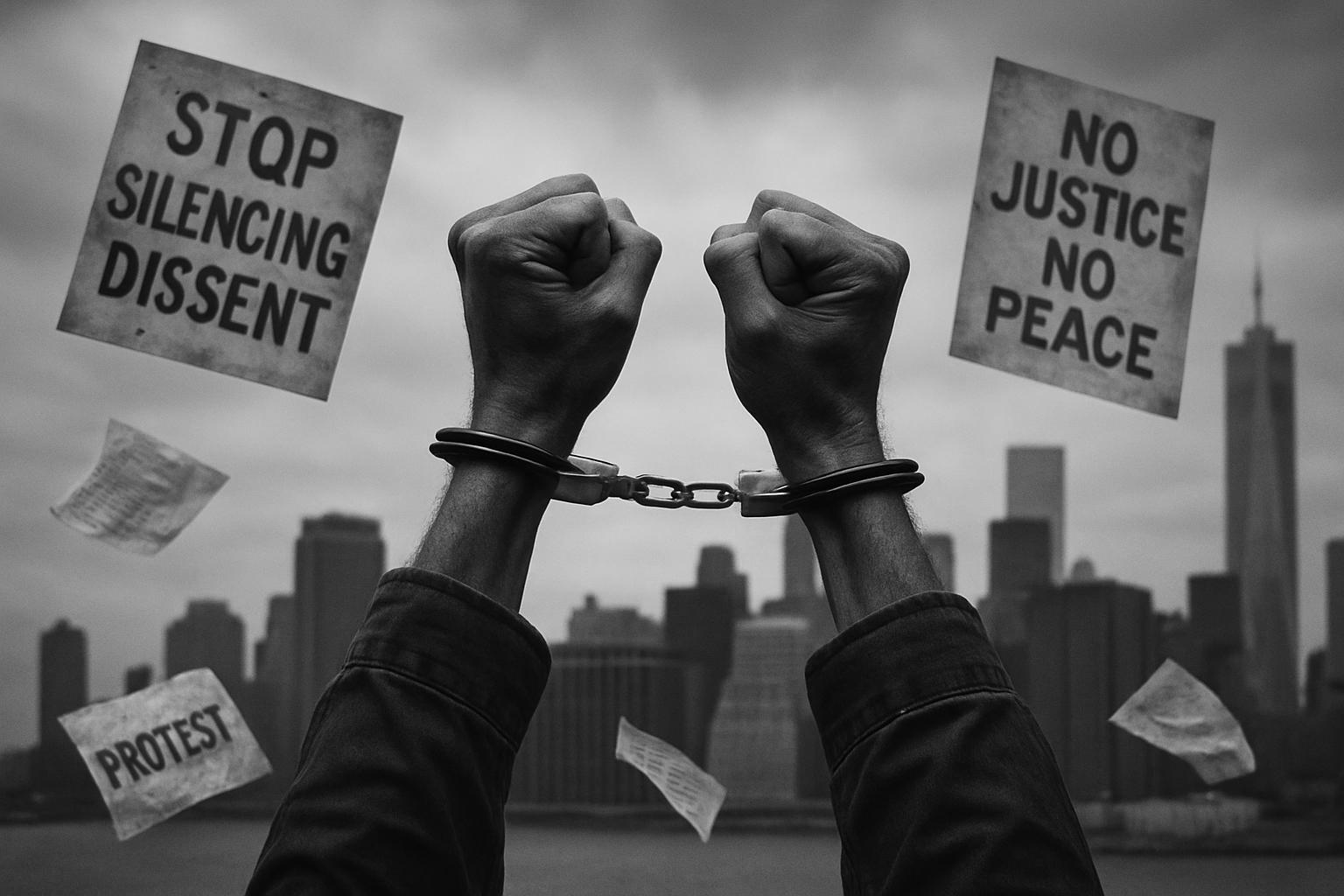
The recent mass arrests of nearly 900 individuals at a London demonstration supporting the banned group Palestine Action reflect the UK government’s relentless push to stifle dissent under the guise of national security. The protest, which took place in Parliament Square, saw 857 people detained simply for expressing solidarity with a cause they believe in, with an additional 17 arrests related to assaults on police officers during violent clashes. This unprecedented crackdown exceeds anything seen since the days of the poll tax riots, vividly illustrating the government’s authoritarian turn.
Since Palestine Action was proscribed in July 2025 under the Terrorism Act—as part of a wider campaign to silence critics—the government has increasingly employed draconian anti-terrorism legislation to target ordinary citizens. The organisation was designated for its alleged direct actions against military aircraft and defense firms linked to Israel, including damage to facilities at a Royal Air Force base. But critics argue that this broad application of the terrorism label is a dangerous overreach designed to suppress legitimate protest, with the legislation now wielded to imprison those exercising their basic democratic rights for up to 14 years.
The crackdown has met fierce opposition from opposition politicians, human rights advocates, and protest organisers, who rightly condemn these arrests as an attack on free speech. Labour MPs have dismissed the broad application of anti-terror laws as “absurd” and “authoritarian,” highlighting the targeting of peaceful demonstrators—including elderly citizens, healthcare workers, clergy, and even a blind wheelchair user—whose only crime was holding up a sign reading, “I oppose genocide, I support Palestine Action.” This is a clear indication that this government values suppression over dialogue, turning lawful activism into criminal acts.
Security Minister Dan Jarvis confidently defended the government's actions in Parliament, asserting that these measures are grounded in independent assessments and that Palestine Action is not a legitimate protest group but one involved in violent and criminal acts. Yet, this narrative conveniently ignores the reality that many of those arrested were simply exercising their right to free speech—some with placards aligned with the official message of solidarity. The government’s refusal to differentiate between lawful protest and violence signals their intent to crush dissent at all costs, regardless of the impact on civil liberties.
The stance taken by the government underscores a dangerous shift toward authoritarianism cloaked in national security concerns. The Liberal Democrats and human rights organizations have rightly warned that such mass arrests could set a chilling precedent, effectively penalising peaceful protests and silencing opposition voices. Amnesty International has labeled this crackdown “deeply concerning,” emphasizing that this is the largest number of arrests linked to protests in over a decade, with the potential to drastically curtail the right to assemble and express opinions freely.
Organisations like Defend Our Juries report that a diverse cross-section of society—former detainees, NHS workers, and ordinary citizens—have been caught up in this purge. Many have since been released on bail, but the threat remains that the government’s broader agenda is to silence any criticism of its foreign policy or domestic priorities. Despite legal challenges initiated by Palestine Action’s advocates, the government remains steadfast in its attempts to justify these measures, demonstrating a clear intent to undermine civil liberties in the name of national security.
These arrests follow a pattern of escalating repression, with similar actions taken across the UK, including in Edinburgh, where protests against arms sales to Israel have also been suppressed. Since the proscription, more than 1,400 individuals linked to opposition protests have been detained—an ominous sign of the government’s willingness to silence dissent through intimidation and heavy-handed tactics.
While some political figures, like the shadow home secretary, support the government’s crackdown, others, including former Labour leader Jeremy Corbyn, have openly condemned it, warning that it undermines the very foundations of peaceful protest. This contradiction exposes the deepening divide within the political landscape, highlighting a government increasingly detached from democratic principles and more concerned with maintaining control than safeguarding liberties.
The unfolding controversy surrounding Palestine Action is more than a dispute over a banned organization—it’s a stark reflection of a government relentlessly dismantling civil liberties under the pretense of security. As the courts deliberate, the fight to preserve the right to peaceful protest will serve as a critical test of Britain’s commitment to democracy and freedom in the face of an increasingly authoritarian regime.
Source: Noah Wire Services