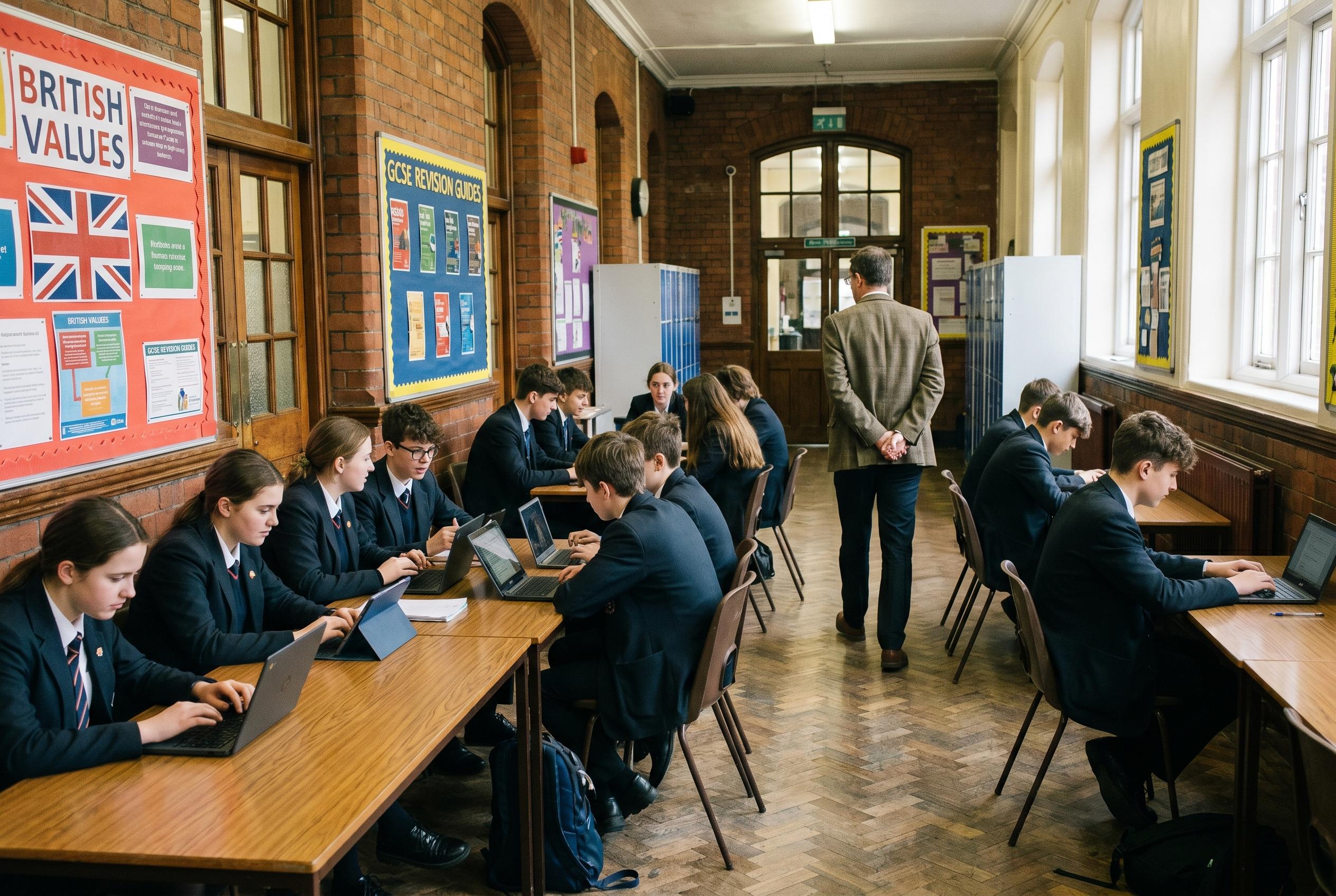
While confidence among educators remains low, UK schools are set to pilot AI tools extensively, as the government launches a £23 million initiative to embed AI responsibly and effectively in classrooms amid wider strategic reforms.
Artificial intelligence is moving from the margins of school and college life towards the centre of education policy, but confidence among educators is still lagging behind the pace of change. One recent survey found that only 43% of teachers felt confident using AI, while respondents rated their ability at just three out of ten, underlining a widening gap between ambition and readiness. At the same time, a University of Illinois Chicago survey found that while 95% of students said they were confident using AI responsibly, only 51% had actually been taught by instructors how to do so, suggesting that formal guidance is struggling to keep up with classroom reality.
That challenge comes as the government steps up its push for AI and edtech in schools. Speaking at the Bett UK conference, Education Secretary Bridget Phillipson announced a £23 million expansion of the EdTech Testbeds programme, with the aim of bringing more than 1,000 schools into trials of new AI tools and measuring their effect on pupil outcomes and teacher workload. Officials have also signalled that a longer-term digital strategy is on the way, as part of the forthcoming Schools White Paper.
The expanded testbed approach is intended to encourage evidence-led adoption rather than rushed enthusiasm. Government guidance on the EdTech impact testbed says the idea is to support schools and colleges in evaluating technology systematically, while the wider EdTech Demonstrator programme has long been framed as a means of helping institutions use digital tools more effectively. In practice, that means schools need to begin with a clear problem to solve, whether that is easing marking pressures, improving feedback or supporting lesson planning, and then test whether AI actually helps.
Governance is becoming just as important as experimentation. Institutions that want to use AI responsibly are being urged to set out firm rules on authorship, citation, ethical boundaries and acceptable assistance, especially where assessment integrity is concerned. UNESCO has also noted that two-thirds of higher education institutions are already developing guidance on AI use, reflecting a wider international move towards formal policy rather than ad hoc classroom practice.
The practical lesson for schools and colleges is that AI works best when staff and students are given both confidence and limits. Teachers can introduce tools in low-stakes settings, such as idea generation or explanation of difficult concepts, while reinforcing that critical thinking, verification and judgement remain human responsibilities. If the government’s strategy is to translate into stronger teaching and better student outcomes, institutions will need to pair investment with training, governance and a clear sense of purpose.
Source Reference Map
Inspired by headline at: [1]
Sources by paragraph:
Source: Noah Wire Services
Noah Fact Check Pro
The draft above was created using the information available at the time the story first
emerged. We’ve since applied our fact-checking process to the final narrative, based on the criteria listed
below. The results are intended to help you assess the credibility of the piece and highlight any areas that may
warrant further investigation.
Freshness check
Score:
8
Notes:
The article references recent events, including Education Secretary Bridget Phillipson's announcement at the Bett UK conference on 21 January 2026 regarding a £23 million investment to expand the EdTech Testbeds programme. ([gov.uk](https://www.gov.uk/government/speeches/education-secretary-speech-at-bett-uk-conference?utm_source=openai)) This indicates the content is current. However, the article also cites a UNESCO survey from 2 September 2025, which is older and may not reflect the most recent developments in AI adoption in education. ([unesco.org](https://www.unesco.org/en/articles/unesco-survey-two-thirds-higher-education-institutions-have-or-are-developing-guidance-ai-use?hub=84636&utm_source=openai))
Quotes check
Score:
7
Notes:
The article includes direct quotes from Education Secretary Bridget Phillipson's speech at the Bett UK conference. ([gov.uk](https://www.gov.uk/government/speeches/education-secretary-speech-at-bett-uk-conference?utm_source=openai)) These quotes are verifiable through the official transcript. However, the article also references a UNESCO survey from 2 September 2025, which is older and may not reflect the most recent developments in AI adoption in education. ([unesco.org](https://www.unesco.org/en/articles/unesco-survey-two-thirds-higher-education-institutions-have-or-are-developing-guidance-ai-use?hub=84636&utm_source=openai))
Source reliability
Score:
9
Notes:
The article cites reputable sources, including the UK government's official website for Education Secretary Bridget Phillipson's speech ([gov.uk](https://www.gov.uk/government/speeches/education-secretary-speech-at-bett-uk-conference?utm_source=openai)) and a UNESCO survey ([unesco.org](https://www.unesco.org/en/articles/unesco-survey-two-thirds-higher-education-institutions-have-or-are-developing-guidance-ai-use?hub=84636&utm_source=openai)). These sources are authoritative and reliable. However, the article also references a UNESCO survey from 2 September 2025, which is older and may not reflect the most recent developments in AI adoption in education. ([unesco.org](https://www.unesco.org/en/articles/unesco-survey-two-thirds-higher-education-institutions-have-or-are-developing-guidance-ai-use?hub=84636&utm_source=openai))
Plausibility check
Score:
8
Notes:
The claims made in the article align with known trends in AI adoption in education, such as the UK government's investment in EdTech and the development of AI guidance by educational institutions. However, the article also references a UNESCO survey from 2 September 2025, which is older and may not reflect the most recent developments in AI adoption in education. ([unesco.org](https://www.unesco.org/en/articles/unesco-survey-two-thirds-higher-education-institutions-have-or-are-developing-guidance-ai-use?hub=84636&utm_source=openai))
Overall assessment
Verdict (FAIL, OPEN, PASS): PASS
Confidence (LOW, MEDIUM, HIGH): MEDIUM
Summary:
The article provides a comprehensive overview of recent developments in AI adoption in education, citing authoritative and verifiable sources. However, the inclusion of a UNESCO survey from 2 September 2025 introduces some concerns about the freshness of the information. ([unesco.org](https://www.unesco.org/en/articles/unesco-survey-two-thirds-higher-education-institutions-have-or-are-developing-guidance-ai-use?hub=84636&utm_source=openai)) Additionally, while the article references a £23 million investment announced by Education Secretary Bridget Phillipson at the Bett UK conference on 21 January 2026, the content does not provide direct access to the full speech or detailed information about the EdTech Testbeds programme. ([gov.uk](https://www.gov.uk/government/speeches/education-secretary-speech-at-bett-uk-conference?utm_source=openai)) Therefore, while the article is generally reliable, the inclusion of older data and the lack of direct access to the full speech and programme details warrant a medium confidence level in this assessment.