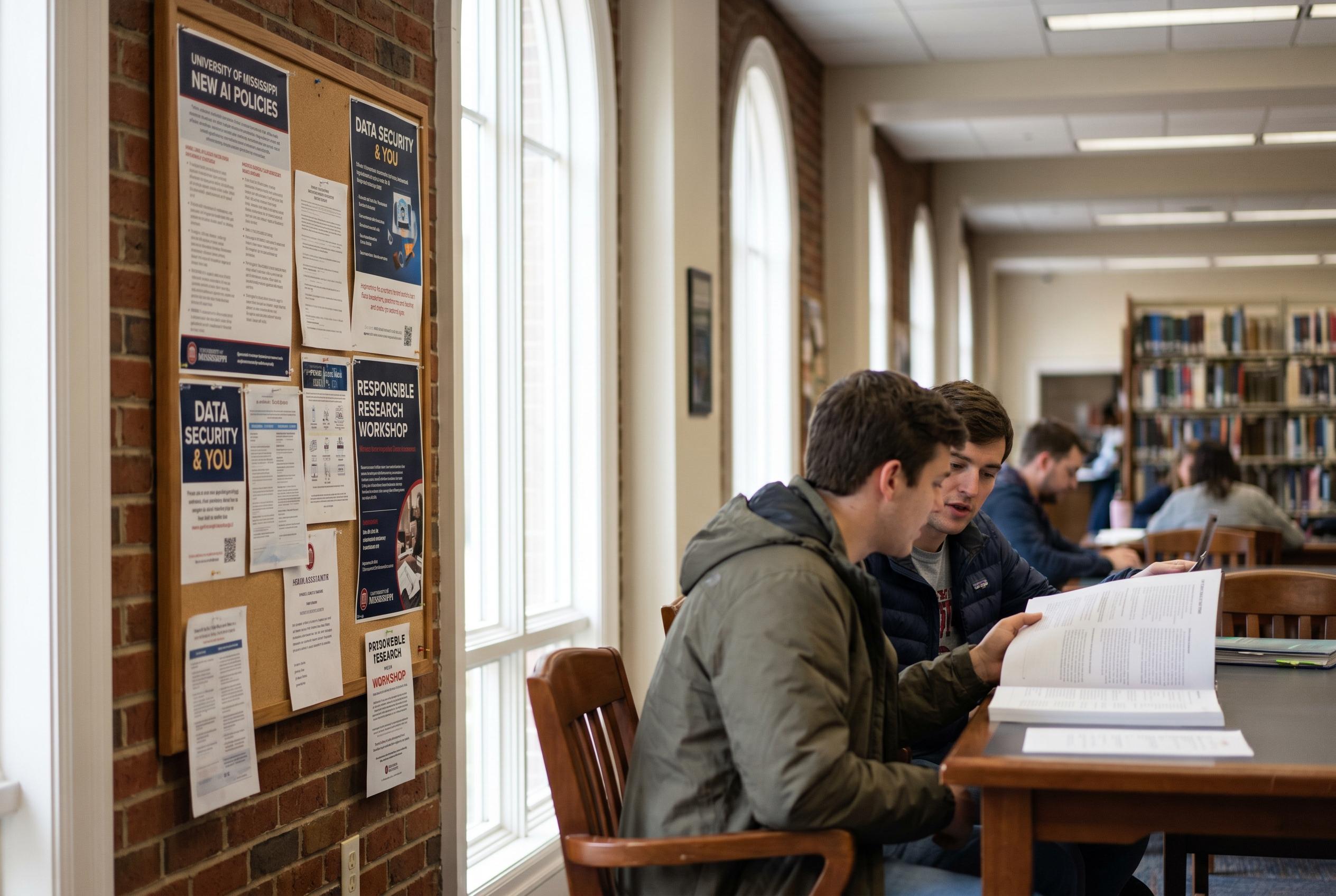
The University of Mississippi is moving toward a more structured approach to artificial intelligence in teaching, but it is doing so department by department rather than through a single campus-wide rulebook. According to The Daily Mississippian, the current system leaves individual professors to decide how students may use AI in their own classes, creating uneven expectations across campus. The new effort is intended to continue into the autumn semester.
The push follows a recommendation from the university’s AI Task Force teaching and learning subcommittee, which has been examining how new AI tools are affecting coursework, research and campus operations. The university’s AI Task Force says it is designed to help build community around AI and data science, while also developing guidance and best practices for the provost’s consideration. It typically meets quarterly and has spent the 2024-25 academic year working on policy recommendations and faculty development.
Joshua Eyler, who chairs the teaching and learning subcommittee, told The Daily Mississippian that the university wants departments to have the resources to shape rules that fit their own academic cultures. He said a one-size-fits-all policy would be difficult because disciplines differ widely in their methods, expectations and norms.
That approach may be easier for smaller schools, such as the School of Journalism and New Media, which has just three departments. Dean Andrea Hickerson said those units may converge on broadly similar standards, though journalism and integrated marketing communications could still diverge on issues such as truth, accuracy and creative use. She also raised the possibility that separate departmental policies could eventually be folded into a single school-level policy if students become confused by differing expectations.
By contrast, the College of Liberal Arts has 21 departments, and Stacey Smith, assistant to the dean, said work there has not yet begun because of the coordination required. The college expects to start after graduation, given other priorities in the academic calendar.
The task force is also looking beyond classroom policy. Robert Cummings, executive director of academic innovation, said its wider brief includes university-wide guidance on teaching, research, service and business practices. At a recent meeting, Marc Watkins discussed the rise of AI agents, which can perform multiple tasks with less direct prompting than earlier generative tools. He said that shift raises new concerns because users remain responsible for the output even when software is acting on their behalf. Watkins also warned that AI could distort student teaching evaluations if agents are used to generate responses.
The group has additionally discussed whether students might receive access to Google’s Gemini through the university, a conversation that began in October and is set to continue at the next meeting in May. The University of Mississippi’s broader AI work comes as other institutions, including the University of Southern Mississippi, have already published task force structures and responsible-use guidance, reflecting a growing higher-education effort to balance innovation with academic integrity, privacy and transparency.
Source Reference Map
Inspired by headline at: [1]
Sources by paragraph:
- Paragraph 1: [1]
- Paragraph 2: [2]
- Paragraph 3: [1]
- Paragraph 4: [1]
- Paragraph 5: [1], [5]
- Paragraph 6: [1], [2], [3], [4]
Source: Noah Wire Services