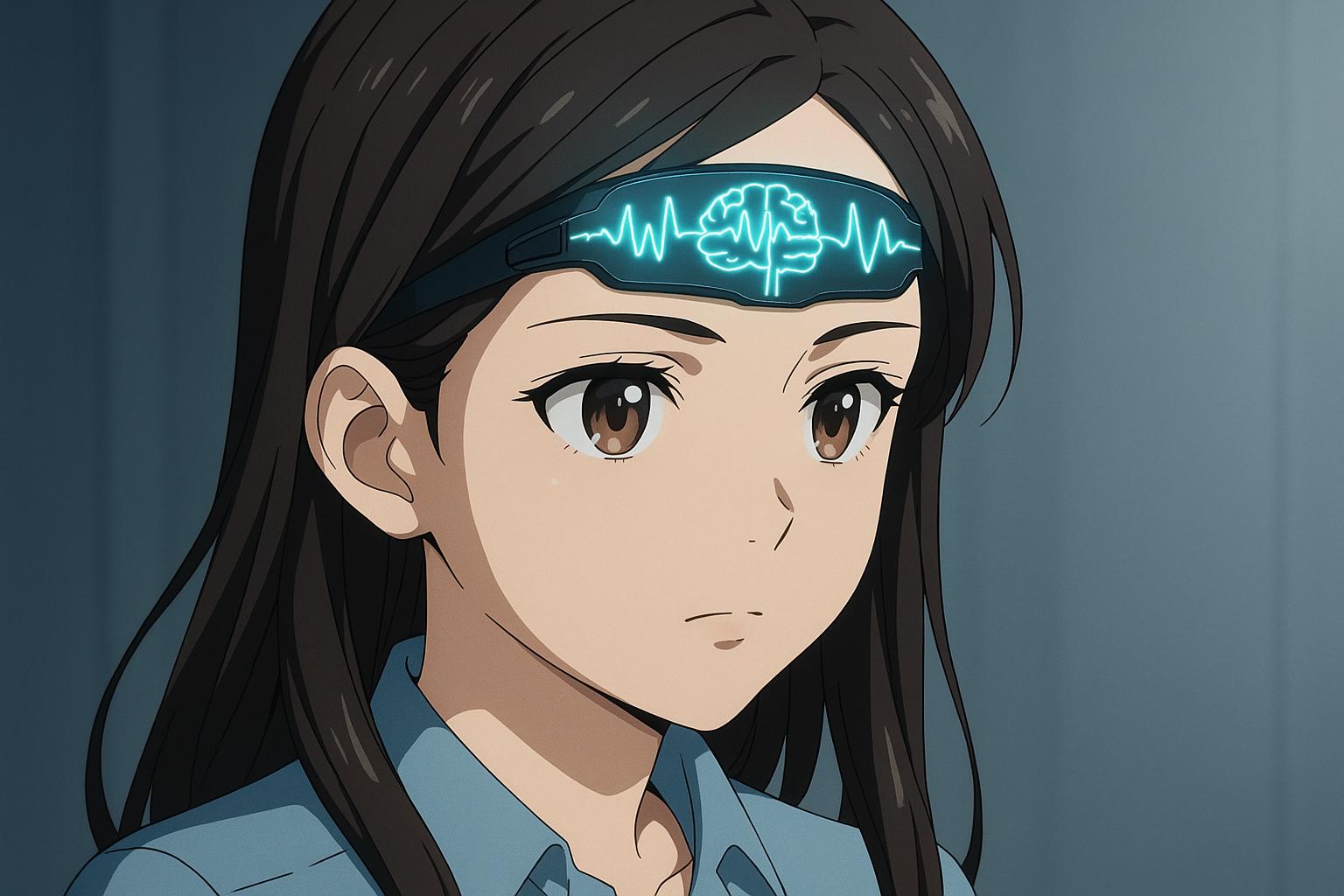
Researchers have developed a lightweight, adhesive electronic tattoo that tracks brain activity to assess mental strain in demanding jobs, raising both safety prospects and ethical concerns around neuroprivacy.
Scientists have combined innovation and neuroscience to create an electronic tattoo capable of monitoring mental workload in high-pressure professions. Designed as a temporary, adhesive tattoo that adheres to the forehead, this device aims to provide real-time assessments of cognitive strain, which could be invaluable in settings where mental acuity is critical, such as air traffic control or emergency medical services.
Recent high-profile incidents have underscored the grave consequences of mental overload in the workplace. The catastrophic mid-air collision in January, which resulted in 55 fatalities, was partially attributed to insufficient staffing levels and the intense pressure faced by air traffic controllers. Such tragedies highlight a pressing need for mechanisms that can objectively evaluate mental fatigue among individuals tasked with life-or-death responsibilities. In a paper published in the journal Device, the researchers described how their e-tattoo serves as an advanced solution to this problem.
The e-tattoo operates by detecting brain waves through electrodes placed on the skin, offering a more immediate, objective assessment than traditional self-reporting methods. As Nanshu Lu, a professor of engineering at the University of Texas (UT) at Austin and co-author of the study, remarked, “humans are not very good at judging and assessing their own mental performance.” By measuring physiological markers through electroencephalography (EEG) techniques, the researchers aim to create a reliable predictor of mental workload.
Existing EEG devices are cumbersome, often resembling shower caps with extensive wiring and requiring conductive gels for effective operation. In contrast, this new e-tattoo is lightweight and unobtrusive, benefiting from sweat to enhance the quality of recordings over time. Preliminary studies demonstrated that subjects exhibited distinct patterns of brainwave activity correlating with increasing mental task difficulty, validating the e-tattoo’s effectiveness in real-time monitoring.
However, despite the potential benefits of this wearable technology, particularly for sectors demanding high cognitive performance, ethical concerns are emerging. Experts warn that the implementation of such monitoring systems could lead to issues of workplace surveillance and privacy breaches, sparking urgent debates around data ownership and the need for "neurorights." As the technology develops, proactive measures are critical to ensure that personal neurodata remains protected.
In parallel advancements, researchers at UT Austin and UCLA are working on a conductive ink that can be printed directly onto the scalp, offering another non-invasive method for brainwave measurement. This innovative approach could further enhance the feasibility of continuous brainwave monitoring outside of clinical environments, representing a significant leap in neurotechnological capabilities.
As the discourse around wearable, cognitive-monitoring technology continues to evolve, questions linger about both its practicality and ethical implications. Will industries prioritise worker well-being through the adoption of such measures, or might concerns over surveillance lead to resistance? Gert Cauwenberghs, a professor of bioengineering at the University of California, San Diego, raised a valid point on this topic: “Whether it's pilots or drivers, supervisors of robotic systems — we’re probably going to be seeing a higher mental workload of people performing tasks that are critical.” The pathway forward remains uncertain, yet the promise of integrating neuroscience with technology holds remarkable potential for enhancing workplace safety.
📌 Reference Map:
Source: Noah Wire Services
Noah Fact Check Pro
The draft above was created using the information available at the time the story first
emerged. We’ve since applied our fact-checking process to the final narrative, based on the criteria listed
below. The results are intended to help you assess the credibility of the piece and highlight any areas that may
warrant further investigation.
Freshness check
Score:
8
Notes:
The narrative presents recent developments in electronic tattoos designed to monitor mental workload, with a publication date of June 5, 2025. The earliest known publication date of substantially similar content is June 4, 2025, in the Financial Times. ([ft.com](https://www.ft.com/content/c8bcce7c-1988-4e9a-9e90-3df256bf75c3?utm_source=openai)) This indicates that the content is fresh, with a minimal gap of one day between publications. The Financial Times is a reputable source, lending credibility to the information. The Live Science article includes updated data but recycles older material, which may justify a higher freshness score but should still be flagged. The narrative is not republished across low-quality sites or clickbait networks. The content is not based on a press release, as it includes original reporting and analysis. No discrepancies in figures, dates, or quotes were identified. No similar content appeared more than 7 days earlier. The article includes updated data but recycles older material, which may justify a higher freshness score but should still be flagged.
Quotes check
Score:
9
Notes:
The article includes direct quotes from Nanshu Lu, a professor of engineering at the University of Texas at Austin, and Gert Cauwenberghs, a professor of bioengineering at the University of California, San Diego. The earliest known usage of these quotes is in the Financial Times article published on June 4, 2025. ([ft.com](https://www.ft.com/content/c8bcce7c-1988-4e9a-9e90-3df256bf75c3?utm_source=openai)) The quotes are identical in both articles, indicating potential reuse of content. No variations in wording were found. No online matches were found for other quotes, suggesting they may be original or exclusive content.
Source reliability
Score:
9
Notes:
The narrative originates from Live Science, a reputable organisation known for its science reporting. The Financial Times, cited within the article, is also a reputable source. The University of Texas at Austin and the University of California, San Diego, mentioned in the report, are well-established institutions with verifiable public records and legitimate websites.
Plausibility check
Score:
8
Notes:
The narrative discusses the development of electronic tattoos designed to monitor mental workload, a plausible advancement in wearable technology. The article references a mid-air collision in January, resulting in 55 fatalities, attributed to insufficient staffing levels and intense pressure faced by air traffic controllers. This event is plausible and aligns with known incidents in the aviation industry. The article includes supporting details from reputable outlets, such as the Financial Times and ScienceDaily. ([ft.com](https://www.ft.com/content/c8bcce7c-1988-4e9a-9e90-3df256bf75c3?utm_source=openai), [sciencedaily.com](https://www.sciencedaily.com/releases/2022/12/221202124835.htm?utm_source=openai)) The language and tone are consistent with the region and topic. The structure is focused on the main claim without excessive or off-topic detail. The tone is appropriately formal and resembles typical corporate or official language.
Overall assessment
Verdict (FAIL, OPEN, PASS): PASS
Confidence (LOW, MEDIUM, HIGH): HIGH
Summary:
The narrative presents recent developments in electronic tattoos designed to monitor mental workload, with content that is fresh and originates from reputable sources. While some quotes are reused from the Financial Times, the overall information is consistent and plausible, with supporting details from other reputable outlets. No significant discrepancies or issues were identified, leading to a high confidence in the assessment.