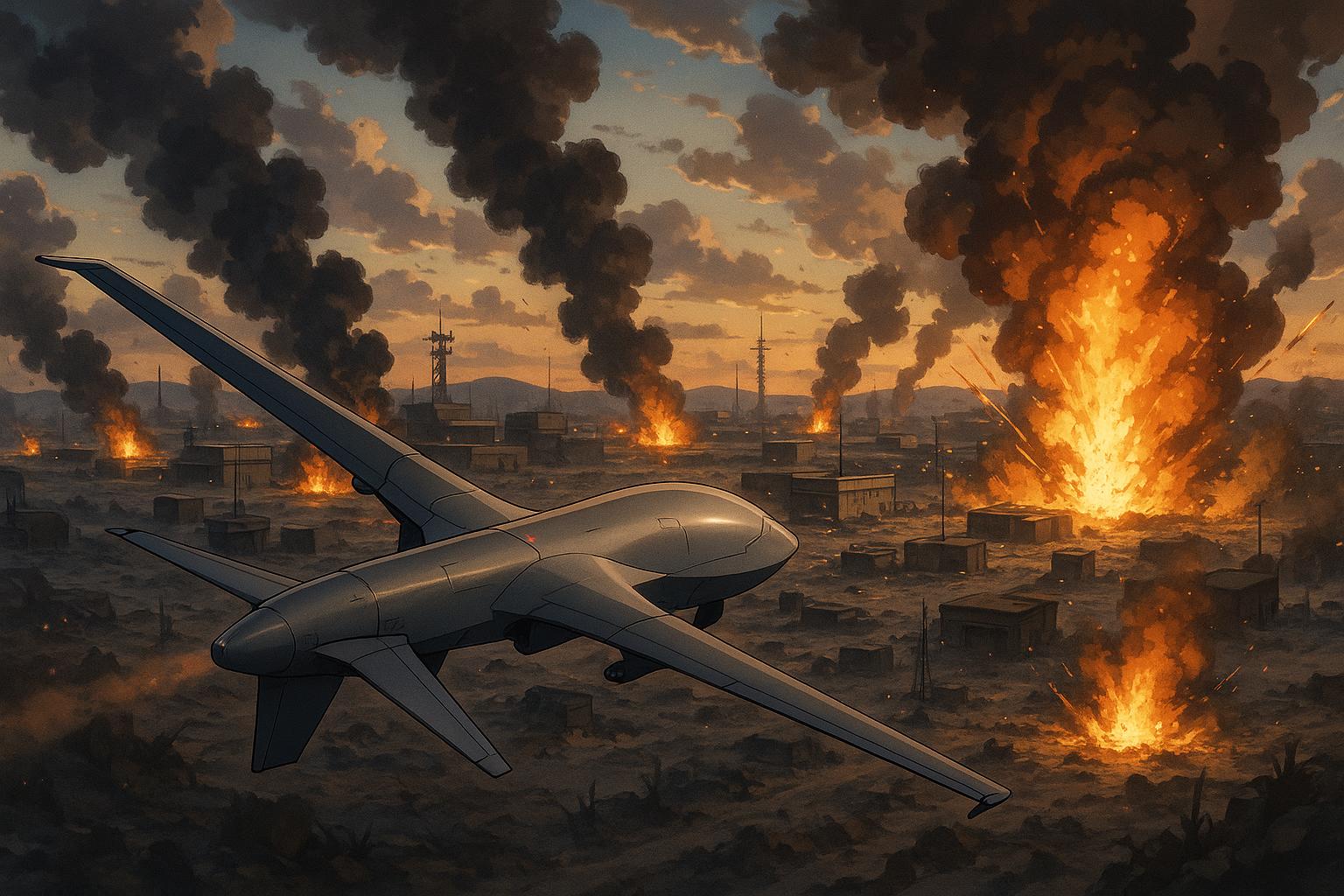
The recent drone strike by Ukraine against Russian military targets has dramatically underscored the shifting landscape of modern warfare. A sequence of events began on June 1, 2025, with Ukraine launching what has been termed “Operation Spider’s Web,” a highly sophisticated and meticulously planned operation. This initiative reportedly involved the deployment of small, autonomous drones, which were concealed within freight trucks and trucked to points near Russian air bases. Once deployed, these drones managed to inflict significant damage on Russian warplanes, particularly a number of long-range bombers that are essential to Moscow’s military capabilities.
This operation has drawn considerable attention to the strategic use of drones in conflict. Kateryna Bondar, a fellow at the Wadhwani AI Center at the Center for Strategic and International Studies, remarked that Ukraine's goal is to transition from traditional warfighters to autonomous unmanned systems. Such innovations in warfare reflect a game-changing approach, where the nations best equipped with advanced, AI-driven technologies could gain a substantial tactical edge.
The consequences of this drone strike are far-reaching. Initial U.S. assessments suggested that approximately 20 Russian aircraft had been struck, with 10 confirmed as destroyed, although Ukrainian President Volodymyr Zelenskiy's figures claim an even more significant impact. In contrast, Russian Deputy Foreign Minister Sergei Ryabkov stated that while the aircraft were damaged, they would be repaired, indicating a clear disparity in narratives concerning the operation's effectiveness.
Recent commentary has highlighted a pattern of innovation in military tactics, comparing this operation to historical precedents like Israel’s strategic deceptions against Hezbollah and even the ancient tale of the Trojan Horse. These comparisons underscore the importance of surprise and adaptability in military strategy, yet they also raise urgent questions about the lethality and unpredictability introduced by modern technology. Innovations in drone warfare have rendered traditional military assets increasingly vulnerable, prompting military analysts to advocate for improved anti-drone infrastructures.
The implications of these advancements extend beyond Ukraine to larger geopolitical concerns. U.S. military leaders have faced criticism for potentially preparing for conflicts using outdated tactics, with some officials warning that the current conflict is indicative of a broader transformation in warfare. Representative Jason Crow, a member of the House Armed Services and Intelligence committees, noted that the war between Russia and Ukraine has fundamentally altered our understanding of modern combat. He highlighted the disproportionate spending by the U.S. on antiquated military strategies and equipment that may lack relevance in contemporary conflict scenarios.
In Europe, the heightened awareness of the need for robust military readiness is palpable. Countries such as Sweden are undertaking significant upgrades to their civil defence infrastructures, intended to shelter millions from potential aerial assaults. Moreover, military analysts have remarked on Finland's decision to withdraw from landmine treaties in anticipation of possible confrontations, as well as Germany’s contemplation of conscription to bolster its armed forces.
Such historical caution is reflected in the broader military strategies of nations across Europe and Asia, which are increasingly prioritizing the development of drone technology and counter-drone systems. Taiwan and Israel, in particular, are adjusting their military doctrines to account for the heightened threat posed by drone capabilities, an evolution that is seeing a shift from traditionally heavy military investment to the deployment of more adaptable, less costly solutions.
As tensions escalate and the frequency of such incidents increases, the potential for a broader conflict remains a real concern. The Atlantic Council recently reported that nearly 40% of military experts anticipate a global war within the next decade. While such predictions may seem alarmist, they reflect an important consideration for nations preparing for a future where asymmetric warfare tactics, like those showcased in Ukraine, dominate the battlefield.
In this new era of warfare, where autonomous drones and innovative tactics redefine engagements between nations, it is essential not just to observe but to adapt. The transformative nature of warfare in the 21st century urges not only an examination of technological advancements but also a re-evaluation of strategic assumptions and military preparedness across the globe.
📌 Reference Map:
- Paragraph 1 – [1], [3]
- Paragraph 2 – [1], [2]
- Paragraph 3 – [4], [5]
- Paragraph 4 – [6]
- Paragraph 5 – [3], [7]
- Paragraph 6 – [1], [3]
- Paragraph 7 – [1], [4], [6]
- Paragraph 8 – [7]
- Paragraph 9 – [1], [6]
Source: Noah Wire Services